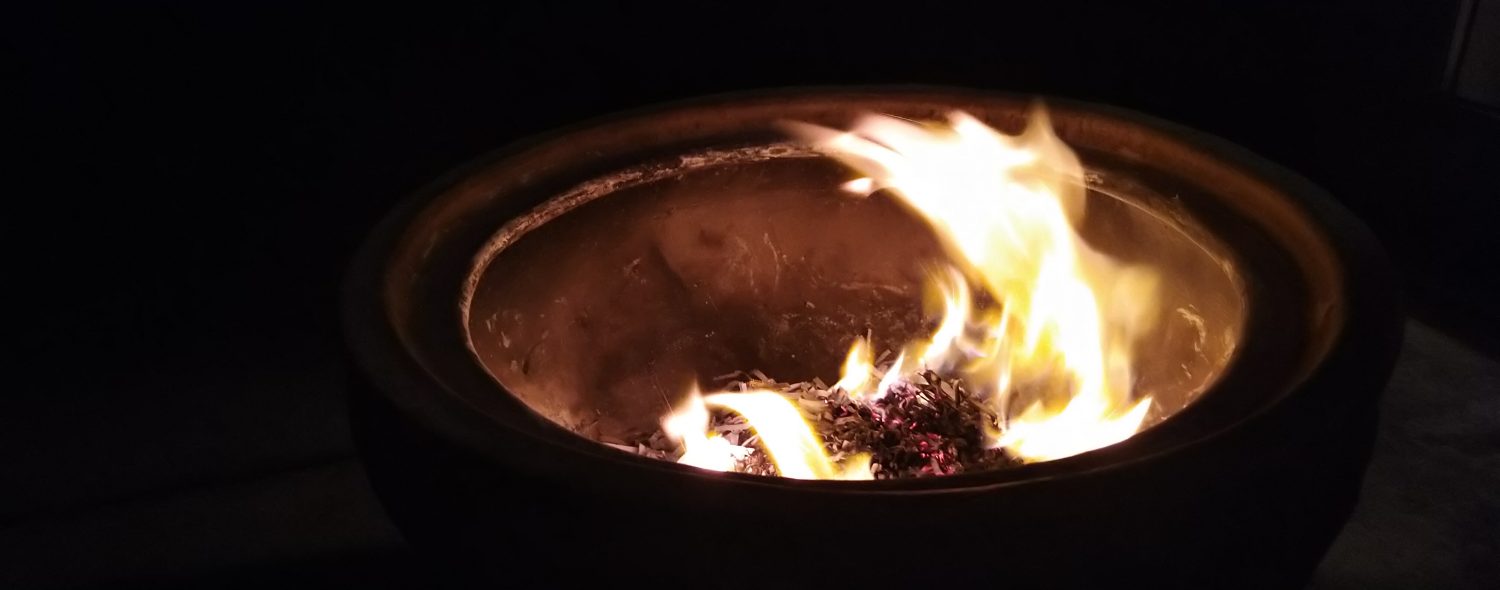
I’m a Quaker; this is why.

It should be said much more often than it is that inviting questions when you haven’t worked out the answers yet is a Bad Idea. I learned this the hard way a few years ago, when I said on Facebook “I’m a Quaker; ask me why.” When someone did just that, I tied myself into a Gordian knot of “well, I suppose some people say…” and “I don’t mean you can’t” which confused everyone concerned and in no way answered the question. This week being Quaker Week, I’ve decided to have another go. So, in a slightly more premeditated way, here is my answer: this is why. It’s a different answer to the one I would have given 15 years ago; a different answer, no doubt, to the one I will give in 20 years time; but it is as true as it can be right now.

Lights and darkness, hope but not too much hope. A candle burns in a bedroom window, surrounded by lighted windows and a starry sky. In its reflection, the candle has just been blown out.

Loyalty. The Quaker community has been a constant throughout my life. As I have moved around the country, new Meetings have welcomed me into membership and joined the chaos of my family life. Quakers introduced me to my husband; gave me my first kiss; made me believe that there were others around me who valued me just as I was; gifted me with friends without whom the world would be a darker place and I probably wouldn’t be here at all. There are prophets in this community who dare to say the things no one wants to hear; lone tigers who do terrifying things against everything society and their quieter minds are telling them; people who shape the norm and people who shatter it; people I love and people I honestly can’t really stand. Every one of those people has an equal place and an equal voice and without any one of them, this community would be poorer. They took me in and made me strong enough to take on a world I would often rather avoid. They have loved me and my children, baby-sat for us, driven us around the country to gatherings and weddings and conferences, and quite frankly, have dug themselves far too deep into the centre of my being for me to just get up and walk away.

Challenge. There is beauty and peace in worship that consists mostly of silence. It isn’t easy, though. It’s very hard to hide when all there is is you and a Light that is digging around in all the dark corners you haven’t hoovered for quite some time and were really hoping no one would notice. I frequently go into Meeting with a Big Question I want answered: you know, “what should I be doing with my life?” or “how can I make world peace happen by lunchtime next Tuesday?” I usually come out with no answers at all, but more questions; or answers to questions I hadn’t dared to ask; or instructions that go beyond anything I want to admit to. In decision making I find myself going in the opposite direction to my expectations; in daily life I am suddenly, utterly convinced with no premeditation or control that this is what Needs To Be Done.* And then I have to live with that knowledge, that decision, that call, and try to hold on to that certainty when the clouds of the world roll over those beautiful starry skies and I cannot remember, quite, what it was that I saw there.

Discipleship. “By this will all men know that you are my disciples: if you have love one for another.” (Always in a soaring melody, for me, never spoken.) To me, the stripped back act of discipleship, of following the summoning and the footsteps of Jesus, is about talking the talk and walking the walk and living a life that rings true, resonating through my bones and becoming a conduit for a Love far greater than I am. I find the strength to yearn towards this through the stillness of Quaker worship. I’ve tried other styles of worship; I find them moving, energising, interesting, intellectually stimulating, educational, tedious and baffling, but I do not find them to be a way to the still small voice that lies in the midst of chaos and noise and walks the straight path through me. If I spend too long away from that deep pool of stillness I get cranky and lose my way. Much like I do when I haven’t eaten, or haven’t slept. All these things are equally fundamental to my being.

Action. Quaker is a doing word. It is about seeking opportunities to serve our society, making tea and keeping the buildings standing and caring for each others’ health and well-being and taking care of all our resources; it is taking a proactive role in our local communities; it means playing a role in politics, in social witness, in showing how business and ethics can work together to make the world more peaceful, more sustainable, break out of the current mould. It means finding the paths you are meant to get involved in and jumping in with two left feet if that’s the only way to do it, rolling up your sleeves, getting muddy and tired and lost along the way and knowing you are doing it for all the right reasons. It is saying that faith without works or works without faith are both meaningless, as each informs, drives, sustains the other. It is saying that even when these ambitions are achingly out of reach, the very hope of trying is itself an action.

Are Quakers perfect? Of course not. A worshipping community is like any other kind of family. Some are full of light and love and silly in-joke moments. Some are filled with darkness, forbidding silences, fear of crossing the threshold because there is nothing left within them of the goodness they once aspired to. And most are somewhere in the middle, with times of brilliance, and times of apathy, and times when you can’t quite put your finger on what’s wrong, but somehow, everything is just uncomfortably askew. It’s in those trying moments that worship binds us together, striving to live God’s love in a world that really, really needs it. And it’s in the moments that we shake each others’ hands when we disagree, when we agree, when we celebrate and grieve and struggle together, that we are closest to Him.

*This has been, at various points, praying, moving house, teacher training, calling my Mum, and any number of other things at other times.

Soft times are going: being part of the change

“It isn’t so much that hard times are coming; the change observed is mostly soft time going.”

A week ago today, millions of people went out on the streets, chalking their hopes and furies onto walls; pavements; each other. It was one moment in an evolutionary story. It was a chance for weary prophets to draw in breath, feasting upon the energy and optimism of those not yet broken by the inertia of others who will not care. It may be a turning point; it may be another marker on a chaotic scattergram of things the youth of the 21st century choose to care about; it may be seen as mass hysteria if we discover that the dramatically changing climate is not, in fact, in any way affected by our presence on this world, and it is just humanity showing off its crazy-huge ego once again.

I couldn’t be part of that striking moment, which to me is an unexpected diamond in the string of plastic beads that thread together the realisation that doing something to reduce humanity’s negative impact on the world around us is a no-brainer. To make my contribution, I spent 7 days keeping track of the actions I take, trying to consider their greater impact. As any fluctuating participator in dietary fads and avoidance tactics such as myself will be able to tell you, nothing holds you to account quite like writing down what you are doing – both the positives and the wrappers you’d rather hide behind the back of the sofa. Even better, telling other people about it allows shared stories and mutual re-invigoration. So here’s what I’ve been doing, diesel-car driving and all. How about you? What’s your story?

Day 1: Saturday dawned bright, sunny, and a perfect start to a renewed way of looking at things. Full of enthusiasm and with a family day ahead of me, there were plenty of wins today. We went to the library (got to love a guilt-free book fest), hung the washing on the line to dry, put together a bag of clothes to donate to charity, watered the plants using water from the butt left behind by our predecessors (which obviously meant that it started raining about 15 minutes later). It was not a day without its downsides, though. These would become the features that, on good days, bad days and just a bit meh days, would form a constant muttering behind me, the monotonous burble of “actually, never mind the rest of it, are you ever going to do anything about us?” Overusing my lovely diesel car, moving slightly too fast, trying to combine tasks into single trips but consequently driving round and round and round and round, depressingly frequently in rush hour traffic jams full of everyone else in the same town also trying to fit errands and clubs and emergency shopping into the 15 minutes of unscheduled time they have squeezed in that week. Energy-boosting, energy-crashing, pre-packaged, plastic-wrapped snacks eaten when not hungry because it feels the only way to get from home time to bed time. Tumble-drying school uniforms and only checking the labels afterwards because frankly, even on good weeks I don’t have the energy for 15 rounds with The Cowgirl when I have the temerity to suggest that, in a lack-of-washing emergency situation, it might not be the end of the world if she wears a skirt instead of trousers.

Day 2 arrived and saw me waving the flag for multitasking vicars’ wives everywhere, as I represented the college I work for at a civic service in my husband’s church. (Getting TOIL for going to a service I was going to attend anyway, you say? That is what I call winning at life.) My positive actions for the day started with a rather lovely outfit, if I do say so myself, bought second hand and already worn by someone else from eBay, with accidentally matching shoes. Later, we looked at food as a family, and made a set of lolly sticks to try to balance the variety I need to keep some kind of sanity around cooking dinner with The Paleontologist’s need to be the boss of Everything In The World. They should also be a way of cutting down food waste, avoiding too much of today’s negative action: having to throw away a loaf of bread that had been sneakily lurking behind some gorgeous flowers gifted to us by a parishioner, and was now mouldy beyond salvation or freezing potential.

Other highlights of the week (by which I mean other actions playing on repeat because that is what life is like on the days I’m at work) included walking between different teaching sites and eating leftovers for lunch instead of taking trips to Aldi. They also included this week’s champion success story: taking my winter coat to have its zip changed. To put this into context, I sewed up the scuppered zip as a temporary fix the night before catching the train to Paris for our tenth wedding anniversary. My colleagues have been mocking me for the year and a half since then that I’ve spent struggling to get it on over my head. This gold-medal-winning moment happened as a result of seeking concrete actions to put in this post. The act of observing and recording genuinely did change my behaviour. Please don’t ever let OFSTED hear me say that.

Over the week, I tried harder with some things, and noticed my own hypocrisy with others. As a lifelong vegetarian who has been resisting giving up dairy with the passion many meaties show in the face of giving up bacon sandwiches, this is not an unfamiliar feeling. This is a process, for all of us. I’m not ready to give up my car yet, and neither is my local transport system. Reducing food waste, on the other hand – that is something we definitely can do. And let’s face it, with the utter unknown of Brexit just round the corner, wasting less food and working better with whatever we happen to have in the house might just become something we all need to go back to being better at. Chaotic uncertainty does have a way of making us appreciate what we used to have. Let’s just hope we all get there before we reach the point that no one will have anything any more.

Re-finding wonder: peer pressure and climate catastrophe are not the end of the story

Is it just me, or is it pretty much impossible to teach your own children anything?

A couple of years ago, when The Cowgirl was still at nursery, she came home one day and started a conversation that I genuinely believed I was never going to have to have.

Cowgirl: I can’t be a doctor. I’m a girl, so I can be a nurse.

Me: ??? ? ???

Cowgirl: Only boys are doctors.

Me: But, but, but, your Godmother is a doctor, remember?

Cowgirl [scrunching up her face in concentration]: Oh. Yes. [Suddenly her brow clears.] She’s got short hair. [Sits back in satisfaction at having won that one good and proper.]

So there we go. Girls can only do things like being doctors if they have hoodwinked everyone into believing they are actually boys, by having short hair.* But how did The Cowgirl imbibe this view of the world? We’d read books that had strong female heroines; talked about all the great things girls had done (and occasionally touched on some of the rather fun things boys had done too); made it clear at every opportunity that had come up – and created some where it hadn’t come up – that any job is for any one, be they male, female, or non-binary. We avoided gendered clothes wherever possible (no Girls Can Be Princesses and Boys Can Be Anything here). And still, here we were, finding all this undone by outdated cultural stereotypes inadvertantly introduced that day in an environment that we had chosen, but could not control.

This was not the last time that this happened, it will come as no surprise to hear. Wanting to have exactly the same snack, backpack, shoes, hairstyle, toys, holidays, car, skin colour, as their friends is a regular conversation around the dinner table (though that might partly be because the number of their friends who have been to Disney World, Florida is growing every year). Fads come and go, and everything I do to celebrate or deny them seems to fall on deaf ears. Every day, they come home full of the importance of combatting climate change (hooray); wanting to wear make up to school (boo); wanting to join a sports group (hooray); wanting to never read a book again (boo). Then the next day, the wind changes, somebody sneezes, and that determination is out of the window and its opposite is now true. Not only that, it always has been true, and it clearly always will be true. Seriously, anyone who thinks that 1984 is a novel that came up with new and horrific ways that people can be brainwashed into believing things entirely contradictory to their previous opinions has been away from primary school playgrounds for far too long.

So how, then, am I to encourage my children to do the things that lead them to a stronger relationship with the world, with other people, with God? One such relationship is to “rejoice in the glory of God’s continuing creation” (an ideal Quakers link closely with care for and stewardship of the world and all the life dependent on it). Can that become something that is relevant to their experience, link with their daily lives, their own beliefs and expectations of the world, and yet still take them by surprise and fill them with awe and wonder? My own view of the glory of creation is very traditional: that inward breath when you drive round a corner and the sun is setting into the sea in front of you; the sweep of a line of mountains marching into nothingness; the infinite gentleness of a butterfly landing on a dandelion flower. The peace and overwhelming presence of nature is where I see God most clearly, and find it easiest to settle into joy.

Sunset over Dubrovnik, lights shining across the town. Cable car wires disect the picture; islands disappear into the ocean and the clouds. A moment that still makes me suck in my breath at its absolute perfection.

As I have said, my children are not like me. And the world that they inherit will not be the world that I grew up in. Most scientists agree that our view towards the world and the elements will change, as they fight back and become something to fear, to hide from, that bring destruction in their wake. Moments of peace and enjoying the presence of entirely oblivious butterflies, dragonflies, bees as they busy around us might become something I will talk about, and my children will have to grope into the distant reaches of their memories to recall at all. Travelling to foreign lands where the air is thinner and God lies in every stone and corner should become something that is done once in a lifetime, not the expectation of every summer holiday. So where, in all of this, will my children find the glory of God’s creation?

It seems that I need to change my interpretation of continuing creation. It cannot be something static, something permanent, something that has always spoken to me in the past; it lives and breathes and shifts around us, through us, with us as we are all continuing to form new relationships. It is within technology, within people, within buildings and structures and artwork and abandoned empty spaces, just as much as it is within the grand old bones that make up this planet. It will be a challenge for me to find things within this brave new world to rejoice in, as I say goodbye to the things that seemed easy and seek to look harder and deeper and question the assumptions that I have been making all along.

Maybe, in fact, I need to ask my children to help me with this one.

*(I would like to clarify at this point, just in case she’s reading this for the record, that no-one could ever mistake this magical Godmother for anything other than the fabulous, beautiful woman that she is…)

The Big Bad Maybe Later

This will come as a surprise to absolutely nobody: I am rather inept at saying no. Slightly more unusually maybe – or at least, slightly less talked about – is being equally bad at saying yes.

So how do you go through life saying neither no nor yes? By becoming a master of the unholy trinity: We’ll See, Maybe Later, and I’ll See What I Can Do. Used effectively, they will answer any situation known to humanity, and are as useful in a classroom as they are in any number of parenting conundrums. In fact, The Paleontologist has started predicting my response, and has changed her questioning technique, asking open questions whenever possible: “Why can’t we have bubblegum ice cream?” is a frequent opening gambit. Other favourites include “When are you going to let me have a phone?” and the wonderful “Why does our Tooth Fairy give less money than the Fairy that goes to [insert the name of absolutely any other classmate]?” The Cowgirl, predictably, approaches things totally differently, dodging asking questions altogether by doing things she thinks she won’t be allowed to do as secretly as possible. Thankfully, subtlety is not as much her forte as, say, running headlong through any obstacle, from rose bushes to recalcitrant authority figures. The time she ate a whole pack of chocolate coins, hiding the wrappers in her pillowcase so that I didn’t see them in the bin, showed particular insight and forward planning. At least, it did until she asked me to plump up her pillow the next evening. Oops.

So I have one child who has developed excellent open questioning techniques, and another who has mastered the art of independence before mastering her 3 times table. This is good, right? Nothing wrong with a bit of healthy noncommittal… Except, of course, we all know there is. And not just the kind of wrong that leads to my more decisive friends and relations (looking in no particular direction, but we both know who you are!) wanting to throw me out of the nearest window fifteen times on any given day. Avoiding both yes and no is a great way of dodging most forms of conflict: if no one (including me, particularly in busy times, or September, or first thing in the morning) knows what I want, they certainly can’t get in a grump if I disagree with them. But it has a deep darkness as a cost. It also means avoiding contentment within myself. Saying yes means saying this is good; saying I’m happy with this; saying this is enough.

There is often a feeling that living a more sustainable life means saying no. You say no to flying and take your chances on holidaying in the UK – may be amazing, may be the end of your marriage and feel like December. You say no to plastic and no to frappacinos, to deodorants bought in your lunch break because you forgot to put any on this morning, to sanitary towels, to the basic fundamentals of everyday living. You say no to meat, to cheese, to takeaways, to many of the things that make busy lives both enjoyable and achievable. You say no to all the things other people are doing, heart pounding as you say it – will they think you’re judging them? Are you judging them?

What if, instead of saying no, simple living was all about saying yes? It would change my perception of it dramatically if I could navigate that mindshift. Here’s an example of when I’ve tried. A few days ago, I went on a train journey to the very North of Scotland – and, as if 7 hours on a train (plus delays, of course) wasn’t enough, three days later we came back again. I was, obviously, not optimistic about the whole experience. Two children, one tablet, tired Mum, Dad away with work; what could possibly go right? But then came the magic. The first bit of magic was my previously-mentioned saintly mother saying yes to buying magazines for both children. Hooray for plastic toys! Hooray for Ninjago mini-figures! (That’s Lego, if you’re not up to speed with the latest lingo the kids are using.) Hooray for activities, and quizzes, and facts that keep science-crazy munchkins engaged for… well, actually for hours. We also had activity books, Top Trumps (cathedrals in one pack, dinosaurs in the other – only in my family…) and an ancient game of Master Mind that involves breaking a code set by the other player. And with that, we survived. We not only survived, we thrived. Both Mum and I managed to spend time reading; in fact, I stopped when I was ready, not before. I genuinely can’t remember when that last happened. It turns out that saying yes to what is directly in front of you, being present and answering questions, reading instructions, then letting the instructions be followed without interference (even when they Do It Wrong), works terribly well, something I used to know, but had let myself forget.

View from a train window, looking out over a very wide river. In the bottom corner is the reflection of a child playing on a tablet.
The beauty of the Scottish coastline. The wonder of a happy child who hasn’t run anywhere for several hours.

Sometimes, I say we’ll see because I don’t know how to even conceive of having the energy to do what is asked (particularly when I’m being asked to build a working robot out of toilet roll wrappers, to take just one example…) And at other times, I say we’ll see because I mean no. Just no. In fact, I frequently mean I’d rather do the school run across hot coals than even think about doing what is asked. (Building a robot isn’t that bad. A whole afternoon of joining in with watching Peppa Pig is.) So I’m setting myself a slightly late #ChallengeAugust. To say no when I mean it; to say yes when I want it; to say we’ll see when I genuinely mean I don’t know yet whether it’s yes or no. Well, apart from when discussing birthday parties. With four months to go until the closest one, any resolution needs a touch of realism and some hard-won messy survival techniques, naturally.

A long bridge curves across a wide estuary, big enough to almost look like the sea.
The rail bridge approaching Dundee. An utterly stunning sweep of countryside.

Everything is connected

One of my all-time favourite films is V For Vendetta. Apart from the obvious moments (after all, right now, is there anyone who would object to Westminster being blown sky high, particularly if empty at the time…) one scene that really resonates is a montage where investigator Eric Finch says “I suddenly had this feeling that everything was connected. It’s like I could see the whole thing, one long chain of events… It was like a perfect pattern, laid out in front of me. And I realised we’re all part of it, and all trapped by it.” His companion, of course, asks if that meant he knew what would happen next, and with typical bluntness gets the response “No, it was a feeling. But I can guess…” And tragedy plays out, giving the film the chance to leave those horrors in maybe-land: did they happen? Did they not? Can the girl with glasses be saved?

“V for Vendetta” by Marko Manev is licensed under CC BY-NC-ND 4.0

We live in a time when every problem is treated as though it stands alone, and every individual is trained to see themselves as an island, with, if they are lucky, causeways connecting them to others, appearing and disappearing with the tides, with never a hint of where the mainland might be found. If you are ill, you get tablets. Tablets for blood pressure; for cholesterol; for headaches; for coughs, colds and not being quite at your best; for anxiety; for depression. Tablets for each individual symptom, as though all of these things are somehow caused separately, interacting independently with the body they have found a home in. Sorting out your work-life balance is a task for every individual, who is then held personally to blame if we get lost in the middle of a perfect storm of demands and expectations and can’t do it by ourselves. Saving the world means cutting your personal carbon footprint, giving up plastic around the home, individual action and sacrifice. The question is always: what are you doing? You as an individual; a family household; maybe, at best, as a town.

Seeing individuals as worthy of value and respect, with God dwelling within them, whatever they have done or thought, however they look and regardless of the capacity for good or evil weighing down their actions, is a gift and a curse and a thing we should all be aiming for. Seeing the individual as the height of all our ambitions, personal glory over a community rising together, has caused lives to fall apart, an ever-widening gap between the rich and the desperate, and Boris Johnson moving into number 10. How much further does this road have left before it splits into so many individual footpaths, some smooth and wide, some rocky and overgrown with nettles, but all leading inexorably into the wilderness of isolation, getting further and further apart, until we can no longer see, smell, hear, any other living things around us?

Talking to students has made me realise how unhealthy expectations in this country can be. One told me that she works so hard that she buys clothes and doesn’t have the time or the energy to wear them. They lie in the bags they came in at the bottom of the wardrobe until, packing for an extended journey home, they resurface, bringing with them the hope they first entered the home with; hope that will now be enjoyed elsewhere, because there is no time for it here. It is so different, she said, in the country she was born in. People there value and enjoy their possessions, their friends, their time. For someone who barely has the energy to brush her teeth at the end of some days, I confess, that sounds like an idyll beyond price.

How have we come to value ourselves and each other so little? Why do we value money so much more than time? During my first year as a teacher, I got used to a day that left the house running for school at 8am and didn’t finish until the next day’s lessons were just about thrown together, usually at about 11pm. I put up with the hours, the expectations, the lack of any life outside the walls I had prepared for myself. I boasted about how bad it was, as we outdid each other with stress levels and caffeine intake around the staff room kettle. But why? The expectation is that in order to have a job with meaning, with satisfaction, that changes things, however small, you put up with what is thrown at you. And acting alone, my choices are suck it up or sack it off, give up, do something else. But what if we all stood together? Not just my union (though we are working on that one); not just those working in the public services; all of us, walking together saying we, and our lives, and the planet are all worth more than mindless, individual busyness?

More time means more ability to slow down, to make from scratch, to take care and do, buy, say the right thing, not the easy thing. To have a sense of achievement from that. To tell someone else about it, and work together so that they can do it too. More life in that notorious balance means more opportunities for joy. And more joy means less greed; less need for eternal, all-consuming growth; more options.

Living within our means is a phrase that has been used for the good, the bad, and the blatantly discriminatory within society over the last decade or so. But when it is used, it is always used to talk about living within our financial means. What would it be like to live within all our means? To live lives where we use the time, the emotion, the energy we have to live our best lives; where nothing is asked of us that we cannot freely give? What would it be like to be able to look ourselves in the mirror and know that we are enough?

It is the summer holidays: traditionally the point that teachers look at their lives and try and sort out all their problems at once, now that they suddenly have space to breathe. I find myself looking at the chaos I create around myself and wondering what we would have to do as a family to live within our time-means. What would we as a country have to change in order to do the same?

Why I wish I could break the rules

A long time ago, in a life-stage far far away, I did something unbelievable. The kind of thing that, looking back even a few days later, I couldn’t believe I really did. One Friday afternoon in sixth form, a group of us decided to leave school early and head down to Glastonbury Festival. We had tents and sleeping bags (well, most of us did. If I remember rightly, one individual named very aptly after a capricious Shakespearean character decided all he needed was a change of socks. Probably best not to ask, really.) We did not have tickets. Crowded into the back of a car, a bit terrified and very excited, listening to Britney Spears and laughing at how terrible the music was, was probably the closest I ever came to feeling like I had a part in the action. 

We parked up and started off in the direction of the fences, which suddenly looked rather more official than they had in my head. Close to the car park were a few scary-looking individuals who had cut holes already, and were charging a nominal fee – sometimes rather aggressively – to get through. We walked on. None of that nonsense for us, they said, though at that point my heart was pounding like mad, imagining that all these eighteen year old lads would be literally jumping over the fence, leaving unhealthy and unfit me on the other side, unable to get in, unable to leave. As was the case far more often than I realised, I suspect, I had underestimated the leaders of the crew. They kept going until we found a gap we could all squeeze through.

You are probably wondering why I am admitting to this now. The truth is, that is just about the only time in my life when I have not only broken the rules, but also refused to feel guilty about it. (Not long after this, the same classmates and I had the choice of jumping a queue or missing the Vatican Museum. We jumped the queue. I still feel guilty about it now.) Even when the news broke, shortly after our return, that so many people had broken in to Glastonbury that they were cancelling the whole festival the following year, we still felt proud rather than ashamed. Proud, and just a tad smug. 

A gorgeous image of the beauty and chaos of such a huge gathering of people.
By jaswooduk from UK – Glastonbury 2011, CC BY 2.0, https://commons.wikimedia.org/w/index.php?curid=18498961

Breaking the rules is absolutely not something I do. Even my acts of teenage rebellion were all within the stereotypes. We not only got our parents’ permission for the Glastonbury trip, for example, we also got our teachers’ permission to leave early (though there is a very good chance we didn’t tell either group we didn’t exactly have tickets…) When I started smoking – sorry, Mum, but I realise now you’re not daft and probably knew the whole time – it was an act of rebellion against my parents, my teachers, my goody-goody reputation; but I waited until I was legal before I started, and always used money I had earned myself to buy them, not money from my parents.

Breaking the rules genuinely makes me shake. Even bending the expectations fills me with quiverings. I seem to have passed this on to The Paleontologist too, unfortunately. When she was much younger and we were living somewhere very different, I took her to the local Eid celebration. It was the kind of party that had 20000 people attending, and its own funfair, so I was expecting her to be in her element. Instead, as we walked the familiar route to the local park that had been transformed into a place for prayers and celebration, her feet got slower and slower until eventually she stopped altogether. “What if they don’t want us there?” she whispered. “What if people like us aren’t allowed?”

I watch people who break the rules with a mixture of awe and horror. Extinction Rebellion have achieved amazing headlines, but my gut rebels at the idea of praising their methods. Greta Thunburg I’m happier with; strikes fit better within the language of revolt from my staunch Labour-supporting upbringing. But do we have to break the rules to be noticed? Does that mean that those of us who feel unable, morally or practically, to take that kind of action have no part to play at all? 

And it turns out that being congenitally incapable of breaking the rules has even deeper consequences than feeling unable to take full part in movements fighting for the things I most believe in. Breaking the rules should be a deliberate act, knowing what those rules are and rebelling against them. Middle class adulting in modern society means following a set of abstract and unwritten rules and keeping yourself and your loved ones within them, accepting the inevitable fallout when you step over a boundary no one ever told you was there. There are rules that deserve nothing less than annihilation; and yet, breaking the rules has consequences, not just for me, but for those dependent on me. And I can’t take that risk. So I struggle on, trying to work them out, only aware of them as they lie in ruins behind me. Have a home. Your own home. Keep that home tidy enough for a photoshoot at all times. Apologise profusely for the way your home looks if anyone pops in unexpectedly, even if it is spotless. Record everything – if a day out isn’t on social media, it didn’t really happen, right? – but whatever you do don’t go getting all self-obsessed. Value all things by their economic worth, whilst also bemoaning that stay at home parents are not treated with the respect they deserve. Recycle everything possible. Talk a lot about climate catastrophe. Own two cars. Go on holiday. Drink plant-based alternatives to milk.

What happens when you can’t keep to the rules? They are so many, so varied, so hidden under layers and layers of obscurity and obfuscation that even in trying to stick to the rules you end up shattering a lot of them. In fact, I’m fairly sure that one of the cardinal rules is to never acknowledge their presence. Some have never seen the rules in action, never understood what is expected and what you are expected to ignore. Many don’t know the rules, have never been shown them, have lived among people with different guidelines and spend every interaction expecting to be called out as a fraud. Some know the rules intimately, using them to their own advantage, manipulating the system to create a world that no one quite knows how to challenge. We have created a system so intricate, so all consuming, so woven into the mesh of our society, our economic system, our values, that we are no longer able to tell apart the rules that do good from the rules that do harm.

There are some rules – morality, decency, love – that deserve to be followed with the rigidity I use when waiting for the green man before crossing the road. Somehow, though, these rules seem to be the ones most neglected within the structures and confines of our everyday lives. Some need to be broken in emergencies. And some deserve to be wiped off the face of the world for all eternity. Particularly the one that says your worth as a person (and especially as a woman) is somehow inherently linked to your ability to keep up with the washing up. I really don’t like that one.

Saying it like this makes it sound so easy. Follow the good rules. Ignore the mediocre ones. Send the bad ones into oblivion. Trouble is, it’s really not always obvious which is which. And the likelihood is, some rules are life-giving for one person and a prison for another. One of my students, for example, the thing she is most proud of is keeping her house spotless. It gives her self-worth in a life that has consistently stripped it away, in a society that would cast her to the bottom of every heap going. How can I say it’s a bad rule that makes me feel terrible, when it gives her acceptance?

Some people see Christianity as full of endless rules. But Jesus didn’t just break the rules. He turned them upside down and ripped them apart from the inside out. He set down a way of life that is still more radical than anything we imagine today, and made it sound so easy to follow – just take your eyes off the rules, and follow love instead. Like every religion, one interpretation tends to dominate media consciousness, and it is never the whole picture. For me it is not about rules. There is one clear commandment, set in three parts (God does love threes…): Love your God, love others, love yourself. Do that and everything will be OK. It broke the rules then, it breaks them now. It seems to me that, thousands of years later, this is still the best advice we have. If we followed these rules, wouldn’t it be marvellous to be able to shelve the rest?

Waste not; want a lot

I have just come back from a little time at the Yearly Meeting of the Religious Society of Friends (Quakers) in Britain. It’s hard to explain what this means to people who have never experienced it, but here’s my current best attempt. Over 1000 Quakers from all over Britain (and a fair few visitors from all over the world) gather in one building in central London for 3 days, and worship and work together to discern where we are at the moment, and where God needs us to be, in ourselves, our community, and the world. It is the very definition of organised chaos – there are never going to be enough toilets for that number of people to use in a 20 minute session break – with a lot of hugging (not a fan) and a lot of gin (bit too much of a fan). Before this year, I would have described the group as fairly homogeneous, but I wouldn’t do that now. Although it is not yet close to being the embodiment of diversity in action that we would like it to be, I think as a Society we will be healthier, happier and able to welcome others more sincerely if we continue and deepen the work done so far, speaking as clearly about how we are already different as we do about how we are the same.

“Quakers Meeting” by Thomas Rowlandson is licensed under CC CC0 1.0

As part of a wider exploration of Privilege and Power, we were also thinking about sustainability in the face of the climate emergency. The words currently ringing through my mind, pushing me out of my comfort zone in all the right ways, are “I need to do everything I can do. Then I need to do a little bit more.” But I don’t want to do a little bit more. I feel like a lot of the time I’m at breaking point already. How can I do more?

But, of course, I can. No, it won’t be easy, or I would have done it before. But as the same speaker said, I can’t look my children in the eye and say, in 30 years time, that I’m sorry I didn’t love them enough to leave them a world they can enjoy with their own children, in the way I can enjoy this world with mine. How can I deprive them of sharing the thrill of rolling headlong down hills covered in wildflowers (and plenty of things we all pretend are not hiding under the grasses); of counting the spots on ladybirds; of always knowing there will be enough food in the cupboards to keep them safe from hunger (even when half a loaf of bread has once more gone fluffy in the bread bin)?

So I need to do more. What can I do? How am I being called to change my life, and through that, help to make being more sustainable part of the collective default?

A phrase that I always associate with my grandmother (who was born into extreme poverty, lived in London through both World Wars and lost her parents-in-law to the Blitz) is “waste not, want not”. She also loved “If a job’s worth doing, it’s worth doing well.” In my head, whenever I hear that, I hear it in my own mother’s voice, with that slightly horrified tone of “did I just turn into my mother?” When I say it (and I do), I would imagine I say it with exactly the same inflection…

Waste not, want not. It has a visceral memory of rationing running clear through it. And it is in direct opposition to most of the way that things are made and marketed in modern society. But what does it mean to me?

The main areas of unquestionable waste in my daily habits are buying clothes I do not need, and eating too much. And in both of these areas, saying no to wasteful habits means saying no to things that I really, really want, if only in that moment. Saying no to consuming more than I need, more than is healthy, more than is right, is saying no to waste. It is also saying that I have to learn to resist the yearning that floods through me for that moment of indulgence and zoning out when tucking into a doughnut or three in the gasp between lessons; or the siren call of inhabiting that body and luxuriating in that lifestyle slithering its way into my subconscious as I dash into town for pens or the chemist.

I am a firm lover of lists and making plans (and usually slightly weaker at actually actioning those plans), and so I have been thinking about how I can create ways around me of reducing waste, and in particular, of stopping throwing away so much spoiled food, and eating so much food that I really don’t need – ways that are sustainable long term, by not adding straws to our already-creaking camels’ backs. I started this year intending to do something different and sustainable every month, a lifestyle change I called #Challenge2019. This (admittedly quite overdue now) is its next installment. So here we go.

I have said before that food waste in our household happens for a number of reasons. I buy healthy food and then don’t have the energy to cook it, so it goes off. (I’m not talking about going past its sell by date here, incidentally – I’m talking liquid cucumbers and green yogurt). I buy chocolate and crisps as occasional treats, and we all end up eating them as the satsumas go hard and brown in the fruit bowl. I cook what feels like the right amount of food, and put too much on our plates, so that we all end up either throwing some away (The Paleontologist) or eating until our tummies hurt (both The Cowgirl and me). I come home from work or days out, full of good intentions, and then snack on cheese because I need a quick boost and everything else takes effort. Then I put too much food on my plate when tea is finally ready and the cycle continues.

Working on all these things at once is impossible for me. Trust me – I’ve tried it I don’t know how many times, and it has never worked. Small changes, embedded one by one and built on slowly, is the only way I can see this working. This week, we’re looking at 5 a day. As a family, our challenge is to eat 5 portions of fruit or veg a day. If we do, we each get to put a cork (reused, of course 😉) into a pot. When there are a full week’s corks in there, we get a family treat.

How does this help sustainability, I hear you ask? I’m hoping, in lots of ways. It will mean snacking on the short-lived fruit and veg already in the house, instead of crisps and sweets. It will encourage me to incorporate more veg into meals, and hopefully give the girls the incentive to eat them instead of them going straight from the pan into the food waste canister. As we all get better at adding daily corks to the family total, I’m also hoping to bring in ideas about where our fruit, in particular, was grown, and how it reached us. And yes, it’s also about encouraging us all to eat more healthily, which might also help me to fit into more of my old clothes, meaning I don’t have to buy more when I have a whole wardrobe of clothes already that I don’t want to admit I may never be able to zip up again. Wouldn’t it be great to address both areas of waste in my life at once?

Is this going to save the world? Clearly not, with just me on my own, saying the same thing over and over to my nuclear family. Is it going to help? Yes. It will help me, but it is also a way of living my faith and my conviction, making the choices and sacrifices I can right now, helping my children and myself see I mean what I say, and that hard choices for me can look everyday and commonplace for others around me. And that’s ok. They may have their own hard decisions which I can support them with, which if we’re all lucky may be something that someone else they know has already overcome, and can show them the way around.

This is me doing everything I can, and then a little bit more. When this is normal, I will do a little bit more of the little bits more. What do you do that is a little bit more? And what can I do to help?

Take a deep breath

soap-bubble-2258904_1920
Image by Gerd Altmann from Pixabay

A couple of years ago, we went on holiday to Valencia. Whilst there, we learned many useful life lessons: beaches and dinosaur museums are almost as good for bribery as Haribo and ice cream; Spanish meal times are the way forward (breakfast until 11 as a normal thing? It makes life so much more civilised!); never expect a child to walk more than 3 metres in direct sunlight, unless you have earplugs or there is ice cream at the end of it (at which point, running and leaving you behind, panting in the heat, becomes way more fun). The most lasting lesson, however, was one I learned alone, on a sun-filled stressful family adventure to the beach. The children were finally old enough to be watched by just one adult, and having a fabulous time getting covered in as much sand as possible, so my husband and I took it in turns to go out of our depth and actually swim in the sea. It had been so long since I’d done this, my body had completely forgotten what to do. Waves came towards me and I panicked, freezing and fighting to stay in control. The wave passed. I remembered I can actually tread water pretty well. I looked out to sea, saw there were no immediate waves, and took a breath. The next wave appeared, and my body started to remember that it knew what it was doing. By the third wave, I had it, relaxing into the incoming surge, focussing on the moment, accepting that when the waves came, they were not there to be fought but to be ridden, to be felt, endured sometimes. And then they passed. There was a moment of stillness in which to breathe.

Take a breath.

It is advice I dish out with joyful abandon, and almost never take myself. I say it to my students: if you are getting panicky in an exam, look out of the window and take a deep breath. Let it out. Count the beats to make sure you are breathing more slowly than normal. Keep going until the voice in your head stops repeating “I can’t do this” at the top of its lungs and lets you listen to the question in front of you instead.

Take a breath.

I do this with The Cowgirl, whose emotions regularly consume her entire being. Excitement needs to be jumped and wriggled out. Exhaustion has her curled in a bundle like a nesting cat. Fury cannot be contained in her tummy but comes out in screams and flying fists. Actually, I think this is probably more healthy than the volcano I often have bubbling in my gut, but that doesn’t help if you’re on the receiving end of one of her deceptively strong left hooks. So she screams for a while until fury turns to fright, and then she huddles on my lap and we recover together. We take a breath, feeling the air together, bypassing our lungs and going straight into our bellies. We compare who has the biggest tummy, and I stop holding mine in. We blow out and try to blow each other over. And we keep taking breaths until the anger has passed.

Take a breath.

Trying to get up when it takes everything in you not to cry at the pain running like acid down your spine, you suck air through your nose as hard as you can. Controlling your body as your instincts control you, you pant through contractions before a long low exhale and a baby’s first, faltering inhale. Laughing like maniacs as you lie on your tummies, sharing secrets, you inhale in whoops to try to limit embarrasing consequences. Learning how the world works and what your interactions do to it, you gently breathe out bubbles, whoosh away dandelion clocks, puff out birthday candle flames.

Take a breath.

The thing about taking a breath is that, however perfect that breath is, however much it gave you exactly what you needed in that moment, it can never be enough to stop, to not need to do it again. In the next moment, after a few heartbeats, you need to do it again. And again. And again. The cycle is always necessary, and endlessly repetitive. Most of the time we pay no attention to it at all, until something comes up that gets in the way and makes us focus by breaking the rhythm.

Take a breath.

Today may be an amazing day. Today is allowed to be the day you get it all right. Today can be the day you have the right answer to a crisis at work, or you get home with the time and energy to chat about discoveries, sorrows and playground shenanigans before the bedtime conveyor belt starts. Today might be the day you keep going with fighting bad habits or finally take a step towards building up better ones. Today might be the day everything goes entirely as you wish it to. And then tomorrow comes, the cycle starts again, and the mystery and mayhem of a new dawn takes over. And tomorrow may not be perfect. And that’s ok.

Take a breath.

Everything that matters in life follows that same pattern. Breathing. Eating. Learning. Loving. Growing plants and making memories. Reading, teaching, worshipping, praying. Sometimes it is perfect. Sometimes it is not. Sometimes it gives you everything you are craving. Sometimes it does not. Sometimes the answer appears in your heart before the sentence has even made it past your lips. Sometimes your cries echo for years, unanswered and seemingly unacknowledged. And whatever the moment, the feeling, the answer, next time, you get to do it all again. We want to see results, to know there’s a reason for all this. The rhythm keeps repeating and we look for meaning from the centre of the cycle and cannot find it.

Take a breath.

That answer will come. Every time you do this, it has an effect that cannot happen without what you have done. Each repetition is important, even when the results can only be seen after a long and cumulative journey. Creating a sustainable future; learning the alphabet; trusting that you are actually doing quite a good job of this whole life thing: all these things are made up of tiny moments, none of which are turning points, all of which are important.

You have this. We all do. Sometimes we can see it in ourselves. Sometimes we need others to find it in depths we are too tired to dig through alone. But it is always there. You’ve got this. If not in this moment, then in the next. Or the next. Or the next.

Take a deep breath.

Choose life*

Can anything really be freely chosen if it is introduced to you at gunpoint?

Quakers have a series of Advices and Queries. They are phrased very gently, whilst pointing out in no uncertain terms that it is probably worth re-evaluating at least some of the fundamental principles by which you have chosen to live your life. If books could speak, they would be heaving a heavy sigh and murmuring “I’m not angry, just disappointed…”

Part of Advice number 41 says this:

Try to live simply. A simple lifestyle freely chosen is a source of strength. Do not be persuaded into buying what you do not need or cannot afford.

Weaving into my mind like bindweed – beautiful, clingy and impossible to get rid of – is this question: Is it actually possible to freely choose a simple lifestyle?

It is possible to live a simple lifestyle in order to reduce your personal impact on the environment. But if you are compelled by the driving terror of global catastrophe, is that really a free choice?

You can do it as a way of living within your means, on a limited budget. But when I think about that, I think about counting coppers out of a jar to buy bread, and borrowing from friends to be able to call the bank and find out why I had no access to any money at all. I am very lucky, and have only been that desperate once. It might have been living simply, but it was not even close to a choice.

You can stand as counter-cultural, deliberately rejecting what is seen as of most value to the modern British mindset; refusing to buy into societal norms, rejecting capitalism with acts of rebellion. But if you define yourself by what you don’t participate in, can that be either a free and personal choice, or a source of strength?

Maybe the real question is what am I thinking when I talk about a simple life? Whenever I think about it, I mostly think about how my life is the complete opposite of simplicity. I think about the chaos of everyday routine, pushing the whole family out of the door Every Single Day before any of us really wants to even be out of bed (except The Paleontologist, that is. It seems that being willing to get out of bed as early as possible is another of those things that skips a generation. It missed her father out by a country mile and landed straight on her. Unfortunately, she inherited the full measure from her Grandad, leaving none at all for her sister.) I think about balancing homework, cooking, phonics, play time and downtime in the witching hour between getting home from After-school Club and sitting down to eat. I think about the school holiday we have just had, balancing church commitments, family time, lesson planning and jobs that never get done in term time, leaving us all more tired at the end than we were at the beginning (and with the washing baskets just as full. How is that even a physical possibility?)

Given all this, I am clearly the perfect person to talk about freely choosing a simple life… I often say, when justifying being a family with two cars, that it is necessary for us to have two cars in order to meet all our obligations. What I actually mean is that we need two cars in order to live the life we have chosen. Could we both get to work without them? No, not with the public transport we have here. Could we move closer to the area we both work in? No, not when the Church chooses where we live. Could we form local connections to help pick up our children so that we can lift share more? Um, yes, but I may have already mentioned that I’d rather chew my own arm off than ask for favours I might not be able to repay. Could we change our work patterns to avoid the necessity of two cars? Yes; but only by one of us leaving a vocation we have both sacrificed a lot to pursue. And we just don’t want to do that.

Given the fact that so many people live lives balanced between chaos and breaking point, how can we picture what a simple lifestyle would even look like?

The need to be better – better than Them, better than ourselves last year, better than our wildest imaginings – drives many of us to never just be. We must always be doing something, because we must always prove, to ourselves and the world, that this is the best moment ever. It is drummed into us from the days of Paw Patrol onwards that that is what is required for a day to be worth living, or recording, or remembering. It is, of course, an entirely unachievable ambition, though the pursuit of it can lead to beautiful moments, as well as the inevitable meltdowns that come when, for instance, this year’s Easter Egg Hunt was not quite up to last year’s standard…

The only way that a simple lifestyle as an achievable desire makes sense to me is to think about what I want to be choosing, not what I would be avoiding. Choose community. Choose fun. Choose habits that lead to satisfaction with yourself and those around you. Choose to be happy with what you have and not compare it to other people’s Instagram lives. Choose local food and playing in the garden. Choose giving away things you still like to others who can’t afford them.* Choose to think in a whole new way, that looks at what is there to enjoy not what is not there to envy. Choose to learn from others’ acts of love and generosity, not sulk that their house is bigger (or cleaner…) than mine. That’s the simple lifestyle I am looking for. And it is only achievable through determined choices, day by day, year by year, one picture, one blog post, one memory at a time.

*For those of you who are my generation, and now can’t get a Scottish voice saying “I chose not to choose life. I chose something else” out of your heads, yes, it was deliberate #sorrynotsorry

IMG_20151009_101345 (2)
A stunning autumn day; The Cowgirl, just learning to run, heads off into the distance.

Second-hand gifts: the perfect solution, or social suicide?

Shh… Don’t let it get around, but I gave a second-hand toy as a gift. At a children’s party. If I had any social standing, it would never recover from this.

I almost didn’t put The Cowgirl’s name on the label. Then I was going to put in a note with an apology, or an explanation. But I realised that no present is even worse than a second hand present, and I ran out of time to write the note (or a card, for that matter), so off the second-hand present went, in a second-hand gift bag, to add insult to injury.

In this pause, having committed to the action but with no idea yet about the reaction, I’m trying to work out why it seems such a suspect thing to do. What is it about gifts that makes them so much more respectable if they are new? If I had regifted something that hadn’t been opened, that would be fine. But the idea of giving away something that has been played with – but still something age appropriate, in good condition, and that is genuinely fun – fills me with feelings of abject failure. No one does it. Ever. I haven’t been to that many parties, by many mums’ standards, but I’ve been to enough to say that with absolute certainty. I don’t want to be labelled the cheap one, or the one who doesn’t care about other people’s children. I don’t want to be the one they mutter about in the playground (“Did you hear what she did? I’m hardly surprised, though, she never irons her kids clothes either.” – That one is true, and something I’m quite happy to own.)

Let me explain why, given all of this, I still gave this particular gift. Maybe this could be that note of explanation I didn’t have time to write earlier.

  1. It was such a lovely idea. Even better, it wasn’t my idea. The Cowgirl came up with it herself, during tea last night. She went off and found the toy she was going to give away, too. And frankly, after such unusual and unsolicited generosity, I’d walk through fire to encourage her, never mind breaking a few social conventions here and there.
  2. It was easier. Yes, it’s true, part of this is because I hadn’t got a present earlier in the week. I did have a plan to buy something on my way home from work, before picking up The Cowgirl, getting her changed, and getting her out to the party – but trust me, it was a huuuge relief when she came up with an alternative.
  3. It let me stick to #ProjectJanuary – I didn’t have to buy anything. Though, full disclosure, I had bought some Spiderman wrapping paper earlier in the week, in an attempt to not leave things to the last moment. Oops.
  4. It was more sustainable. Nothing like practising what I preach, and I do keep saying it’s better not to buy new things if we can avoid it. We have a family list of ways to help the world on the fridge, and giving away things we don’t need any more is squarely on there. It’s nice to actually do something about it.
  5. It helped us clear out. As I’ve said before, we have had a lot of celebrations recently. It was fairly inevitable that at some point, a toy worth having would be duplicated. It was also inevitable, given The Cowgirl’s general bolshiness, she would insist on keeping the new one. Being willing to give away the old one (in the new box – I know, I’m a bad person, but at least it hasn’t been scribbled on) at least means one less thing to squeeze into our over-cluttered home.

So, for all these reasons, I’m taking a stand. I’m not adding to the pile of plastic duplicates killing the oceans one toy car at a time. I’m taking a risk, and seeing what happens. After all, we’ve got The Cowgirl’s own party in a couple of weeks. If they are upset, they can always do the same back to us. You know what – even if they’re not upset, I do actually hope they do the same back to us.