Fixing things that ain’t broke yet

At every point in my life, I have thought to myself that this is it. I am more busy than I have ever been before, and I have reached capacity. I thought it when I was doing my GCSEs (oh, the irony!) I thought it when I was doing my A levels and learning to drive and working, all at the same time. (You know, just writing that made me realise why it is so frustrating when my students complain about balancing those 3 things. Should I have more sympathy, or should I tell them they ain’t seen nothing yet? Choices, choices…) I thought it at University, then again when I was working a few different jobs at once straight after Uni. I thought it when I was working full time and volunteering as a Quaker treasurer. I thought it when I was at home with one child, and then with two. I thought it when I was training to be a teacher. Now, as a full time teacher with still fairly young children, I know it’s true. I really have reached capacity. Never, ever let me take anything else on. Ever. Well, unless something better comes along, obviously. Or something really fun. Or something really worthwhile… And there I go, doing it all again.

Looking back on those earlier times in life, the thing I miss more than anything else is the time to stop, and read, and think. Even in the very early days of motherhood, I remember reading – book in one arm, feeding child in the other, making plans. Of course, I had no idea what was coming, so most of my planning was thrown out over the next six months, but what a glorious luxury that time was, and how little I realised it then.

Time is not something anyone seems to have any more. I recently realised that I have no actual physical parenting books at all, now that even The Cowgirl has officially outgrown Penelope Leach. (On a side note, any recommendations of good books about parenting pre teens would be really appreciated. I can buy them and feel guilty every time I see them unread on my bedside table…) Instead of having time to plan, I go with whatever works – usually whatever leads to a marginally easier life. And once I’ve found the sweet spot of something that gets the job done, I would rather chew off my own arm than change it. Bedtime is one example of that in our household. We still have exactly the same bedtime routine that we set up when The Cowgirl was six months old, at the same time in the evening, because you know what, it works, the girls sleep through, and we have some time in the evenings to do marking, catch up on emails, or, you know, watch The West Wing from start to finish. Again.

It’s ok, I reassure myself. If it ain’t broke, don’t fix it. It’s working well, so let’s not tamper with it. The problem with this, of course, is that the world is changing all the time, and children tend to change five times faster than the rest of the world. As they change, our expectations and responses as parents need to change too. And if we’re going to do this well, they need to change preemptively. By the time you notice that an old favourite isn’t working any more, in my case at least, it’s usually not been working for quite some time, and I’m running to catch up lost ground.

When The Paleontologist was young, her desperate cry when upset was that she wanted a Mummy hug on the sofa. It was a beautifully simplistic time (except for the time when she refused to walk home because she was cold, wet, and wanted a hug on the sofa. It took me half an hour of persuasion, swearing and tears – all from me, obviously – before she agreed to start walking home so that we could actually sit on the aforementioned sofa to have said hug…) Could I use the same comfort now? Well, the hug and the location remain the same, but they have lost some of their magic. They are no longer enough to cure any ill, and instead of being all perfect, the hug is for comfort, not solutions, and the talking, and the crying, and the questions, and the not-having-answers-but-that-has-to-be-OK is where the magic is slowly, so slowly, being brewed. My ways of dealing with childhood devastations have been forced to shift and shudder and get through on a wing and a prayer in a desperate attempt to keep up with growing minds and developing bodies.

Almost every day seems taut with new decisions: tiny individually, but when matted together they become a hedge of thorns that it is almost impossible to get through without getting scratched to shreds. Do we let them open the door without an adult? (Answer: no – remember we live in a vicarage and so you never quite know who will be on the other side of the door, and in what state.) Do we let them check to see if the milk has been delivered? (Answer: yes, but never again – by the time we came downstairs, they had not only got the milk in, they had also drunk the lot of it…) How much freedom do we give them online? How much do we nag The Paleontologist to do her homework, and how much do we let her suffer the consequences of leaving it undone? Do we let her read as late as she wants to (just like her mother…) even if it means that she’s an absolute misery in the morning, because she didn’t get enough sleep (just like her mother…)? I let The Cowgirl choose for herself who to invite to her birthday party, rather than inviting the entire year, and my goodness me, the horror on some people’s faces when I mention this is frankly terrifying.

Looking at the world around us, and our relationship with it, I can see a number of parallels. It’s not broken yet – though the continuing devastation caused by Cyclone Idai tell us that it’s not exactly unbroken either. We don’t want to mess with what works. Our lives and our communities are doing just about alright using the methods and priorities we have set up over a number of generations, and frankly, we just don’t have the time to stop and work out alternatives. Particularly alternatives that will probably not be as convenient. It means letting go of something very dear to us, something that has seen us through some really tough times. It means letting go of the things that made us feel like we are in control and we have this, and moving into the unknown, where we might not be in control any more, and we certainly don’t have this, and accepting that we may never have it again. Why on earth would we do that voluntarily?

But we know the answer to that. Nothing lasts forever, and desperately clinging on to it with both hands still doesn’t stop time passing. Everything changes. The world might not change quite as quickly as our children do, but it still moves faster than we would like. We need to change our relationship with our children preemptively, before we destroy it by trying to keep it static; we need to change our relationship with the world just as much, or we won’t only kill our relationship with our environment, we will kill the environment itself.

Of course, with both parenting and, you know, saving the world, recognising you need to change the approach is only the first step. The even greater challenge is working out what to do next…

img_20190329_0647242
A canal in spring, the towpath fading into early morning mist, concealing the way ahead and the familiar landscape around.

Rocks, ripples, and uncomfortable reflections

Be yourself, they said. Don’t worry what anyone else thinks of you, they said. Follow your dreams, and be what you want to be, they said.

What a mantra to live by. The only problem is, it rather assumes that the thing you want to be is a good thing. In my case, the thing I want to be is perfect. I want all the people around me to be happy, and healthy, and doing things they love. They can even be rich or materialistic if they really have to be. But I want me to be perfect. Perfect in body size – hardly original; perfect at work – outstanding, I think they call it in the trade; perfect as a mother – (hides behind a computer screen rather than going to a primary school violin concert, so that’s a fail); perfect as a vicar’s wife – the kind who serves gin and always knows how to solve other people’s problems, whilst simultaneously fixing the photocopier and booking a donkey for Palm Sunday. All round perfect. So when someone says to me “Be what you want to be,” I hear “You must be perfect. And if you’re not perfect, really, pack up and go home.”

And, quite often, that is exactly what I do. Looking at all the options, I know that I can’t do everything, and the fear of not being perfect stops me from doing anything at all. How is it possible to do the right thing in a world full of endless choices and conflicting needs? I want my children to grow up in a world that is not hurtling towards self-destruction with only an air bag as an emergency break, so I know I should drive my own car less. But I also want my kids to be able to do normal things, like going to the cinema or trampolining with friends. And I know that I don’t have the energy to get them there on the bus – and, more importantly, get them back again on the bus, rather than throwing them under it when they’re exhausted and I’ve run out of food to bribe them with. So I start tearing myself up about what is the right thing to do, and is it selfish to put my children’s needs first, and am I using them as an excuse to put my own needs first, and is that selfish, and before I know it, I’ve turned into Chidi from The Good Place, and I’m about to be crushed by an air conditioning unit filled with my own indecision and self-doubt.*

Or what about what clothes to wear. It’s amazing how many implications just that simple decision can have. I want to wear clothes that make me feel good about myself – luxurious and in control. (Yes, I know that clothes aren’t everything – but I also know the magic of the right pair of shoes.) So, I want to wear clothes that make me feel zingy. But, at the moment, I can’t. All my clothes are just too tight. So now, I have a decision to make. I could go on a diet. There are a few out there that I haven’t tried, and I’m sure they would work if I followed them closely enough. But let’s face it: I know how to eat healthily. I’ve done it plenty of times before, and I’m not doing it now. For today, my priority is keeping going, and sod the amount of chocolate bars it takes me to do it. I don’t want to go on a diet – and that decision makes me feel like a failure, because how can I be perfect if I’m doing something that makes me feel bad and not want to do anything about it? Alternatively, I could buy a whole new wardrobe. I know that would be tempting for a lot of people, but you know what, it’s not for me. It would be utterly unsustainable, as it would have to be fast fashion for me to have any hope of affording enough clothes to wear regularly. Also, I really like a lot of my clothes, and I’m not ready to give up on wearing them again. This would make me feel like a failure, because I’m not perfect at sustainability. Finally, I could keep going with what I have. Which is, of course, the default, and therefore what I’ll probably end up doing. But it’s uncomfortable. And it makes me sad, because these clothes used to make me feel zingy, and they don’t any more. And you know what – that just makes me feel like a failure, without even knowing what I’m not being perfect at.

These concerns are small, and self-contained, and a little bit hyperbolic. They are also fundamental to how we see ourselves and our own struggles. Do we look to the impact on the world, and put it over ourselves? Do we look at how others see us as the most important thing? Do we think about how something will make us feel – will it make me happy? Is being happy the ultimate goal?

Pebbles dropped into ponds cause beautiful ripples that flitter and fade. I don’t want to be a pebble, though. I want to be a rock, that, when dropped into the pond, will never be forgotten – that doesn’t leave ripples, but changes the whole landscape. I want to be noticed. I think we all do. And if I can’t be that rock, well, what’s the point of doing anything at all? But bubbles and ripples bring more joy than rocks. They mean life-giving rain, causing ripples and dimples and flowers to grow. They mean skipping stones and taking time to stop, and breathe, and enjoy. If you’re very lucky, they even mean otters, streaming up and down, hidden, half-seen, heard in the rustling of the reeds before they race away, leaving you wondering if you saw anything at all.

We don’t all have the energy to find exciting new sustainable ways of doing things. We don’t all have the strength to keep going through the fear of failure. We don’t all have the privilege of the financial security to lead slow lives, or the family support to do that. What can we do? If we just do what’s easy, we’re ducking out of one of the biggest decisions of our lives. But it’s a decision that we must all make for ourselves. 

Be yourself, I say. Don’t worry about what anyone else thinks of you, I say. Have the courage of your convictions, and lead the life you are called to lead, I say. But for goodness sake, don’t think it’s easy working out what that is. Have the courage to accept that for a while, you’re just going to have to wander in the wilderness, dodging perfect whenever you can. After a while, your hard work will pay off. You’ll find your way, and you’ll become wonderfully good enough.

otter-1982439_1920
Otter swimming, sending ripples out ahead of her. Image by strichpunkt from Pixabay

*If you haven’t seen The Good Place, and you have Netflix, I recommend it. Both very funny and full of all the best and the worst of moral philosophy – what more could you ask for?

Community, connections, and saying yes: moving beyond giving or receiving

A couple of weeks ago, I got a flat tyre. It turns out that ignoring the warning light because you know something needs doing, and you’ll do it when you get a moment thank you very much, means that sometimes, you end up in exactly the situation the beeping light is meant to avoid. Oops. Now I’m not great with cars, but I can just about use the air machine. I even worked out for myself how to use the flat tyre button, and so was a bit peeved when a random guy came over and terribly helpfully offered totally unsolicited advice. It was 5:30pm, I was tired, and he was patronising, so I may have been a little sarky in my response. The assumption that I needed help just grated, and brought out my inner pre-schooler, insisting on doing it by myself, and probably making the whole job take three times as long as a result.

As it turned out, the tyre was well beyond being fixed by blowing air into it, and I ended up going back to the guy (who was genuinely nice, as well as volunteering for the Air Ambulance). He and his colleague not only agreed (with some surprise) that I had been using the machine right, but also identified the problem with the tyre. They then changed the wheel for me, which is definitely beyond any knowledge I may have had about my own car. I was half way through explaining I didn’t think we had a jack in the back when they slid off a hidden panel and there it was. Good thing there wasn’t anything else hidden in there, really.

Standing at the side of the petrol station, watching two strangers go through the boot of my car, I had another decision to make. The children needed to be picked up ASAP. I could phone our neighbour, who is lovely, and gave me her number at Christmas with the assurance that I should call if I ever needed help picking up the girls from school. Or, I could call my husband, who was busy, stressed, and half an hour away.

I called my husband. Of course. Why? Because it was easier, and I was tired. Because I utterly loathe making phone calls, and making a phone call to someone I don’t know particularly well, in order to ask for a favour, is about the worst kind of phone call I can imagine. Because I didn’t want to look like I wasn’t coping, or was needy. Because she might say no, and I would have gone through all of that for nothing.

It will come as no surprise to anyone that asking for help is not one of my strengths. To be fair, very few of us are any good at it – we all seem to ask for too much help, or, more commonly, none at all. However, this was not just yet another incident of me refusing to accept that I might need help. It was also a case of the offer being made in that fabulously non-commital way: just give me a shout if you ever need help. It’s up there, in my experience, with “just ask if you need a babysitter”, or “if you’re feeling down, just talk to someone”. The times that you really need help are also the times you are lying on the floor in a puddle, hands over your mouth to hold in the panic, and you are damned if you are going to admit that you are not coping with things that everyone else manages with ease. Right now, that tiny dreg of pride is the only thing keeping you from melting into the floor, and you are not letting go of that too.

When The Paleontologist was old enough for me to be desperate for a grown-up night out to not need me around for milk at a moment’s notice, we discovered how hard it is to find babysitters in a new town. We had plenty of people offering help: “just pick up the phone, dear.” I loved that community, but the only time we ever accepted an offer of a babysitter was when someone did not leave the action to me. Instead, she took out her diary, picked up a pen, and said “When shall I come over?” This taught me a lesson I try to replicate, though I often fall short. It is not just that we are really bad at asking for help; we are also, generally, really bad at offering it in a way that lets people say yes.

This affects parenting, making it much harder to form the villages we all need to raise our children well and maintain our sanity at the same time. It affects mental health, leaving the onus on the people who are crumbling, instead of expecting more of those who – at the moment, at least – are more steady on their feet. But it also affects things that are bigger than our individual lives. One of these is our attitude to climate action, and as such, it is something we all need to change.

We all have our own reasons for not wanting to take help. We have our own reasons for not wanting to impose our help on others, too, and most of them are either noble and genuine or so deeply ingrained into the British psyche that it would take the end of the world to get over them. The problem is that all these things make us islands, fighting to survive, standing on our own. Some of us have very small islands – some of us live on them entirely alone. Some of us live there with our families, or close friends. Sometimes they include work colleagues, or your church, or other people who think the same way as you about the things that are important. But all of our islands stop us being genuinely connected to this beautiful shared tear-drop of a planet. They stop us reaching out to help people on our street, forming relationships that will help us work together to reduce our consumption or improve our local communities. They stop us seeing the the world around us as something that we all equally share, and depend on. The air I breathe is merged with my neighbour’s long before it reaches my closest friends; why do I act as though we are not that closely connected?

If we are going to change the world, it isn’t going to be done by individuals taking small actions, though that is a good place to start. It’s not going to be fixed by governments and radical laws, though that will be a necessary piece in the puzzle. We need to change the fundamentals of how we relate to each other, and how we see the world. We need to make community a thing that just happens, rather than something forced and awkward. We need to change our mindsets from What is best for me and mine? to What can I do for all of us? People like me, who might obsess for a week over exactly the right thing to casually say if you see the neighbours in the morning (and therefore end up saying nothing at all) need to take a deep breathe, get out of our introverted comfort zones, and say yes a lot more. We all need to get more specific, and make helping each other routine, instead of being remarkable, patronising, or an act of charity. The best harmonies are those where all the voices have their own lines, weaving and intertwining to create something more beautiful than any individual note. We need to stop practicing our own lines in front of the mirror, getting them to performance standard before we let anyone else know we’ve even been learning to sing. We need to work together with all our stumbles and missed notes, letting the shared melodies carry us through and make us stronger.

birds-2672101_1920

Image by Dieter_G from Pixabay

Of course, saying this is one thing. Doing it is quite another. For me, I think it might be time to step out of my comfort zone and offer my neighbour’s daughter a lift to school. Taking one step at a time, who knows where I might end up?

Beaches, guilt, and yodelling: what really counts as wasted time?

A few days ago, sitting in the sun in the local playground, I put down my phone, lifted my face to the sun, and started to feel guilty about doing nothing.

It’s a beautiful February afternoon, warm enough to not need coats. The Cowgirl is swinging down the slide belly first, yodelling “Nants ingonyama” like she’s opening the Lion King in the West End. The atmosphere has that heavy stillness pulsing through it, as though the air itself is holding its breath, waiting for the coming of summer. Of course, the fact that it’s February and feeling like midsummer is a worry, but winter is still a recent enough memory that it is one I’m willing to ignore right now.

In my mind, I rewind a few days, to a wind-battered beach in North Wales. Perfect kite-flying weather sees me chasing tails and laughing until my blood tingles. We even get the kite off the ground every once in a while. The Paleontologist digs as deep as she can, delighted when she reaches water, finding treasure and convinced it’s a real dinosaur tooth. She stands triumphantly in the newly created moat, in snow boots and a bobble hat, waving the tooth above her head. And in the moments I’m not running after precious comfort blankets or untangling kite strings, my mind is actively seeking how I can use this time more constructively, what I should get ticked off The List while everyone else is happily engaged in activity.

img_20190219_141935-1
A windswept beach in February. Where could possibly be a better place to build a sandcastle?

That gnawing question ignites in my belly every time I stop to play, or think, or pray. I can manage board games for about 20 minutes before cracking and putting on a load of washing. Lunch anywhere but my desk, over marking or incomplete registers, prompts mild panic and causes me to spend the time I should be enjoying food and conversation crafting unnecessary excuses instead. Playing football in the garden? Maybe, but only after I’ve done this weeding. And hung out the washing. Oh, and just picked up these bits of rubbish… By which time the moment has passed, the TV has responded faster than I have, and another opportunity has been lost.

The compulsion not to waste time snakes under my skin and corkscrews into my bones. Each morning, the ticking clock dominates, driving any form of enjoyment further away with every click, ever conscious of every moment wasted not doing Something Useful. How quickly can the children get up, dressed, and into school? Will it be before the traffic locks down every route into work? Once I’m in college, time distorts like a carnival mirror, making everything both bigger and smaller at the same time, consuming everything that lies before it, not letting me finish anything for good. Then, with a rush, the end of the day comes, and – deep breath – it’s time to do it all again in reverse, like some twisted Bear Hunt. Back through the traffic, swear swear, crawl crawl; back through the school gates, hurry coats, hurry bags; back to the kitchen, eat your food, eat your food; back to the girls’ room, pajamas, teeth, story, bed; then they’re tucked in and I’m cowering under my own covers, muttering “I’m never going on the school run again”. Except, of course, I do, tomorrow, and tomorrow, and tomorrow.

And, throughout all this, pushing me on if I ever catch a glimpse of a pause, is that simmering volcano in my belly. Keep running, don’t stop, keep moving. As though if the merry-go-round slows down the centre of gravity will be lost and we will all go spinning off into the uncertainty and vacuum of space. Busyness keeps the wheels spinning; fun makes them wobble. Cooking for dinner whizzes the wheels along smoothly; baking for fun gets a whole lot of flour in the cogs and clogs them right up. Getting up early to go for a run (well, that may be pushing it, but a wheezing jog, anyway) gives a good push start to that day’s rotation; meandering along the same paths in the balmy afternoon sun pulls back on the axle… will it stop? Making Memories and photographing and Facebooking everything keeps the fun boxed in and safely contained, weighed and measured; the same activities done spontaneously and without record feel as though they never really existed. Facebook, Netflix, blogging – things that keep and hold my attention spin the gears and ease the pressure building up below the volcano. But nothing removes it altogether.

Going back to that beautiful coatless afternoon in the park, I sit, trying to ignore my internal volcano, and think about the blossom on the trees, and the daffodil buds, and the lilies in the field. I have always seen that Biblical analogy as a message not to worry – one which I’ve followed only very infrequently. But this day, I accept that it is also saying that these amazing things are so very temporary. They are beautiful, but only if you give them time to speak to you. Otherwise, you miss their majesty because you are too busy with your head in the washing machine and your mind on what happens next. Like life, and Easter chocolates, and childhood, once it’s gone it does not return. So take the time, stop, and enjoy the sunshine, the yodelling, the chocolate. Let the volcano bubble; just keep checking in to make sure the scary Mount Doom eruption is still a little way off. When that moment comes, by all means, let the craziness out or everything will be destroyed by your own screaming. But until then, life is these still, unscheduled moments, and missing them is missing the point behind all the busyness.

I am dust.

Ash Wednesday is dissonant. It is jarring. It makes me wriggle in my chair and want to cower behind the cushions at the same time.

I stand, in a beautiful church shimmering with gold, and have cold, damp ashes thumbed onto my forehead. They were made earlier in the week in my back garden, smoldering in the barbeque as the joy-filled palm crosses disintergrated into black, crispy mulch.

Remember that you are dust.

My children stand beside me, quiet because everyone around them looks different to a normal Sunday, quivering with pent-up energy made worse by knowing they cannot let it out. The solemnity hangs in the air, unexplained, inviting and incomprehensible.

To dust you will return.

My husband turns from me and gently, hand shaking just a touch, marks the cross on the forehead of each child, remembering their own mortality whilst doing everything he can to forget it. At least, that’s what I assume he’s thinking; I know it’s there in my mind.

I stumble back into the real world, awkwardly engaging in conversation when all I really want to do is be still, and breathe, and try to assimilate the fact that I have just had my own mortality literally pasted onto my forehead. In that moment, there is no turning away from the fact that this is me, and I will die, and that is part of why I am here.

Walking down the street, the dissonance follows me. Eyes do a double-take on seeing my forehead. Should I tell her she has something on her face? Is she one of those crazy people? No one mentions it. Everyone sees it.

I leave the church dreaming that this year, everything will be different. I will be thoughtful, and helpful, and kind every day through Lent. I will give up the food that is bad for me, and take up an act of kindness every day. I will pray more, and read the Bible every day, and come out of it knowing exactly what God wants of me.

All too soon, life intrudes again. Tomorrow is World Book Day, and so there is a Paleontologist to be transformed into Hermione Granger, and a Cowgirl who has decided that in fact, when she grows up, she wants to be a Tiger (because the Tiger is very naughty, and eats all the food in the cupboards, and I want to be like that too). Marking needs to be done. Meetings need to be had. Washing needs to be hung out to dry.

Usually, by this point in the evening, my pious intentions have already crumbled into dust. This year, the process started early, as I didn’t even make it to the Ash Wednesday service; the car had a flat tyre, and absorbed All Time into an abyss. So instead, in this pause when the wand is away, the tiger costume is hanging up, tomorrow’s marking is just about finished, and the house is asleep, I am trying to reach that point of stopping, and breathing, and waiting.

Because Ash Wednesday is not just dissonant because it reminds you that you will die, standing there in the midst of the busyness of everyday life. It is also jarring because it throws the knowledge that, in fact, none of this is about me, right into my face. Lent is not a sanctified excuse to lose weight. Nor is it the chance to answer those big questions about where my life is going or what might happen next to me. It’s not a time for self-congratulation, or self-absorption, or starting new projects.

Lent is a time when we remember what it is like to be lost and alone. It is a time of wandering through the desert, not knowing yet how the story will end, and having to trust that everything will happen as it should. It is a time of madness, and forgetting, and self-discovery. It is a time for remembering what it is to be homeless, and hopeless, and hungry. But more than that, more than anything else, it is a time of waiting. It is a time of listening. It is a time of holding on while the storm crashes by, because only then, in the resulting stillness, can the voice of God be heard.

And so, tonight, I am waiting.

field-2179118_1920
Image by Pexels on Pixabay

Letting your life speak: Quiet acts of everyday rebellion

img_20190119_1458261135631769555678487.jpg

One of the things I find hardest about parenting is working out how to pass on deep-rooted principles. In the years since becoming a parent, I’ve done reasonably well (if I do say so myself) at keeping my children fed, clothed and with a decent number of books around them. My husband does an epic job of sorting out health problems, and has seen the inside of children’s A&E more than anyone would ever want to in one lifetime. Between us, we make a good team and have the essentials nailed. But none of this is the same thing as teaching them how to be good humans.

As may have already become clear elsewhere on this blog, I am a Quaker – a member of the Religious Society of Friends. In Britain (and a few other parts of the world too) we don’t really do evangelism. We get terribly uncomfortable if anyone asks us to describe our faith, and usually end up explaining everything Quakerism isn’t, rather than anything it actually is.* Over the years, I have found that the same thing is true with just about anything else that means a lot to me. The more important it is, the more I struggle to put it into words.

So here I am, facing the daily dilemma of how to help my children grow into Good People – which, as it turns out, is something I really, really care about, and therefore don’t know how to talk about at all. That’s OK, I tell myself. I don’t have to talk about it. I’ll follow a classic Quaker instruction, and let my life speak instead. We all know that actions speak louder than words, so I can let my actions do the speaking for me.

Letting your life speak is a wonderful guide to live by, and a fantastic way of avoiding difficult conversations. However, it does rely on one fairly vital ingredient: that when your life speaks, it agrees with what your mouth would say if you had the right words. As our children grow, they tend to mirror back to us our own traits and habits; and this sonic reflection has forced me to acknowledge that actually, what my life is saying is not necessarily what I want my children to be hearing. Why would they believe me when I talk about simplicity, when they also see my congenital weakness for sales racks and charity shops? Why would they believe that faith is central to my life when they see me drifting off not fully focussed in worship? And that’s before we get anywhere near The Cowgirl refusing to even contemplate doing anything that wasn’t her idea, or The Paleontologist developing a serious case of selective deafness whenever she is asked to do chores…

And then, I look around me at some of the amazing people I’m lucky enough to call friends, and I realise that I do know what letting your life speak looks like, even if I forget what it feels like sometimes. I see people who say yes to everything that life offers them, and take leaps of faith that would leave me petrified. I see people slowly and steadily cutting plastic out of their lives, one disposable cup at a time. I see mothers fighting for their children when they hurt so badly that they can hardly stand up themselves. In everything the people I love do, I see tiny acts of global rebellion; their lives shout from the rooftops that there is more than one way to do things, and that the world does not need to have the individual at its heart and self-centredness as its watchword.

The answer to how to help my children be Good People is in fact there right in front of me. It’s remembering that all these things are a process of tiny actions, not one big moment that will change everything. It’s showing them that no-one is perfect and no-one does the right thing all the time, and that what matters almost as much as good intentions is how we deal with doing the wrong thing. It’s about recognising and celebrating all the times I, and they, manage to be Good People together, and remembering that there is another chance tomorrow when we all get it wrong. And it’s about saying yes to every opportunity to let my life whisper, through acts of everyday rebellion, that there is another way. That is how I can really change the world.

*Actually, when I say we, what I really mean is me. I am awful at putting my faith into words, which may be a bit of a problem in this particular post…

Nature Ocean Waters Sunset Dusk Reflection Dawn
The calm before the storm, or sailing straight into one… Photo courtesy of Max Pixel.

Messy Hospitality and Gentle Decluttering: Challenge February

One of the things about living in a vicarage (or a rectory, as I keep being reminded we do now) is that your house is never completely your own. A very smart woman told me a very long time ago, when I was a new and naive clergy spouse, that it is beneficial to make sure that there is at least one room in the house that is tidy enough for visitors at any time, as you never know when someone will stop by.

The intervening years have demonstrated that she was absolutely right, and that the destitute and the Bishop are equally likely to drop by with no warning. These years have also demonstrated that, as a family, we are quite frankly useless at keeping any rooms in the house tidy. Instead, we have learned to practice Messy Hospitality. Anyone who stops by is welcomed in. We always have tea, and we sometimes have biscuits. We usually have gin and a listening ear. And we have piles of paperwork all over the surfaces, and toys all over the floor. This is our home, and it’s chaotic, and if you come in you need to accept that. To me, it’s an important way of saying that mess and chaos don’t need to be left at the door: we’re all pretty messy on the inside, and our houses (and our Facebook feeds) shouldn’t try to disguise that.

So messy hospitality is important to me. A perfectly tidy home does not feel like my home at all. Having said that, staying one step ahead of the mayhem does help me maintain calm in the midst of chaos. My downstairs usually reflects that (unless, of course, it’s a school holiday. Or Ofsted are in my college. Or one of the children is ill. Or, let’s face it, Netflix have just come out with another slightly addictive boxset.) My upstairs, however, is another matter. My bedroom, in particular, is the dumping ground for the rest of the house; all the other rooms become play dens or sleepover venues at some point, but that one is sacrosanct. It is therefore, inevitably, always the last to be tidied. It has piles of goodness knows what in every corner, some of which have been there since we moved in, and all of which are being added to daily, with clutter drifting on top of clutter. In fact, maybe that is where The Paleontologist gets her fascination with digging through layers of dross to find dinosaur treasures?

The problem, for me, with this level of clutter is that it stops my home feeling comfortable, and makes it an extension of the stresses and havoc of everyday life. When every surface has things that haven’t quite been put away, and you have to move 5 things before you can put down your morning cup of coffee, the time has come to take action. Which brings me on to the next part of my #Challenge2019: Challenge February. This month, I want to declutter 10 things every day from my bedroom. This is based on the idea that doing a little every day is more sustainable than big clear outs, and still sees solid results. It’s a principle I first came across on Facebook, created by Less Stuff. They are excellent at actually taking things out of the house and finding new purposes for old objects. In contrast, I’m afraid that when I talk about decluttering I mostly mean actually putting the recycling into the blue bin and putting away all my clothes. I’ve even doubled the amount to do each day in the hope that one month will be enough to see a real difference (yes, it is that bad). Still, the intention is there. Every day, I want to find homes for ten things that are out of place, so that by the end of the month, my bedroom is closer to an oasis of calm than the aftermath of a very localised tornado. You never know: if I get into the habit enough, I may be able to work the same magic on the study as well…

Second-hand gifts: the perfect solution, or social suicide?

Shh… Don’t let it get around, but I gave a second-hand toy as a gift. At a children’s party. If I had any social standing, it would never recover from this.

I almost didn’t put The Cowgirl’s name on the label. Then I was going to put in a note with an apology, or an explanation. But I realised that no present is even worse than a second hand present, and I ran out of time to write the note (or a card, for that matter), so off the second-hand present went, in a second-hand gift bag, to add insult to injury.

In this pause, having committed to the action but with no idea yet about the reaction, I’m trying to work out why it seems such a suspect thing to do. What is it about gifts that makes them so much more respectable if they are new? If I had regifted something that hadn’t been opened, that would be fine. But the idea of giving away something that has been played with – but still something age appropriate, in good condition, and that is genuinely fun – fills me with feelings of abject failure. No one does it. Ever. I haven’t been to that many parties, by many mums’ standards, but I’ve been to enough to say that with absolute certainty. I don’t want to be labelled the cheap one, or the one who doesn’t care about other people’s children. I don’t want to be the one they mutter about in the playground (“Did you hear what she did? I’m hardly surprised, though, she never irons her kids clothes either.” – That one is true, and something I’m quite happy to own.)

Let me explain why, given all of this, I still gave this particular gift. Maybe this could be that note of explanation I didn’t have time to write earlier.

  1. It was such a lovely idea. Even better, it wasn’t my idea. The Cowgirl came up with it herself, during tea last night. She went off and found the toy she was going to give away, too. And frankly, after such unusual and unsolicited generosity, I’d walk through fire to encourage her, never mind breaking a few social conventions here and there.
  2. It was easier. Yes, it’s true, part of this is because I hadn’t got a present earlier in the week. I did have a plan to buy something on my way home from work, before picking up The Cowgirl, getting her changed, and getting her out to the party – but trust me, it was a huuuge relief when she came up with an alternative.
  3. It let me stick to #ProjectJanuary – I didn’t have to buy anything. Though, full disclosure, I had bought some Spiderman wrapping paper earlier in the week, in an attempt to not leave things to the last moment. Oops.
  4. It was more sustainable. Nothing like practising what I preach, and I do keep saying it’s better not to buy new things if we can avoid it. We have a family list of ways to help the world on the fridge, and giving away things we don’t need any more is squarely on there. It’s nice to actually do something about it.
  5. It helped us clear out. As I’ve said before, we have had a lot of celebrations recently. It was fairly inevitable that at some point, a toy worth having would be duplicated. It was also inevitable, given The Cowgirl’s general bolshiness, she would insist on keeping the new one. Being willing to give away the old one (in the new box – I know, I’m a bad person, but at least it hasn’t been scribbled on) at least means one less thing to squeeze into our over-cluttered home.

So, for all these reasons, I’m taking a stand. I’m not adding to the pile of plastic duplicates killing the oceans one toy car at a time. I’m taking a risk, and seeing what happens. After all, we’ve got The Cowgirl’s own party in a couple of weeks. If they are upset, they can always do the same back to us. You know what – even if they’re not upset, I do actually hope they do the same back to us.

#ChallengeJanuary: What not to buy

Never mind January; it’s the end of the year that is all about new things in my household. We have 3 birthdays and an anniversary, as well as Christmas, between Halloween and New Year’s Eve. Bad planning, I know, but there we go…

I love buying new things. I love getting new things. I even love trying new things (as long as they’re not too dramatic, and really not energetic at all). New clothes, new books, new recipes, new earrings, new shoes, new anything, really. I love planning for it in my head, finding it online (or, even better, in one of our lovely local independent shops), and I particularly love wearing it, or using it, or reading it, and revelling in that feeling of newness and hedonism all day long.

IMG_20190102_171911
There’s nothing quite like Rocket Dog boots and dangly earrings…

So there I was, sitting in a Quaker meeting at the end of two months of fairly non-stop newness, thinking about what I might try to change in 2019, and I came across this:

We live in a part of the world where the dominant motivation is material self-interest, justified by the concept of personal freedom. In these circumstances, the rich get richer and the poor, for the most part, become comparatively poorer. […] What are we doing to proclaim our joyful acceptance that our living standards are going to have to drop; what are we doing to join with other Christians and concerned fellow-citizens to proclaim the vulgarity of our affluent style of living; what are we doing […] to recognise the need for change?

Quaker Faith and Practice, 25:12

What this means to me is that I need to get used to the idea that I should have less, so that other people can have more. I should appreciate the gifts that I have, rather than always looking to the next thing, the new thing, the shiny pretty things. My faith tells me that we must treat others as well as we would want to be treated, and always see the best in the world and those around us. This is a way of showing the world God, and what God wants us to do in the world.

In setting myself Challenge 2019, I said that my goal was to find things that have a positive impact, without needing a mammoth amount of energy to complete them. For Challenge January, I am taking that entirely literally. My challenge to myself is to buy nothing that is non-essential for the whole month.* Instead, I will focus on the things readily available to me – those already in my wardrobe, on my bookshelves, and in the world around me. The thing I am most worried about in meeting this challenge is that I will need to find a way to feed that desire for the new, the interesting, the flattering, without constantly feeding my consumerist side. In fact, that sounds like a good topic for #ChallengeFebruary…

*By essential, I mean food, fuel, cleaning products, and school jumpers to replace those that have mysteriously vanished into the black hole that is the lair of the Primary School Jumper Thief. I may also mean chocolate. I think it is very unlikely that I will get through the whole of January without chocolate being essential at least once.

IMG_20160823_182328-2.jpg
A swan, a canal, a beautifully sunny day.

Wobbles and wanderings: it must be Boxing Day

Let’s go for a walk, I said. It’ll get us out of the house and wake us all up, I said. Won’t it be nice to leave behind the consumption and self-centredness of present-fuelled frenzies and get back to nature, I said. Inevitably, the family had other plans.

In my head, Boxing Day is an oasis of calm and tranquility. There are always enough leftovers in the fridge to avoid cooking for a week; no one has to get up and out of the house; there are no deadlines or alarm clocks; there are more adults than children in the house, so keeping the kids entertained is, ahem, child’s play. The house is filled with laughter and good cheer, and it gives us all the chance to recover from the full-on busyness of December.

As you will no doubt have already worked out, the things that happen in my head are not always linked that closely to reality. In today’s case, there was no connection whatsoever. Firstly, The Paleontologist kicked up a fuss. She only wanted to stop building Lego if it meant starting using her new microscope. Then The Cowgirl got involved. So many costumes, so little time, and definitely no room for leaving the house, of all the abhorrent ideas. Next Mother joined in, with questions and wonderings and “I only want to help…” (Which is true, which is a tragic irony, as in fact it does nothing of the sort.)

A decision was made. Celebration time! Oh, no, wait: the Visiting Hound needed a walk. Being a Big Dog, he needed a Big Walk, and needed it right now. Everything was put on hold for another hour.

We did eventually make it out of the house. We even made it through the café and the gift shop, though of course we stopped at both. Eventually, we started a walk around Stowe Gardens. It was overcast, and cold, and we were all either exhausted or ill, so it was more of a meander than a hike. It was also a good way to get out of the house, wake up, and enjoy each others’ company without the exciting distraction of presents and chocolate. In short, actually, it was lovely.

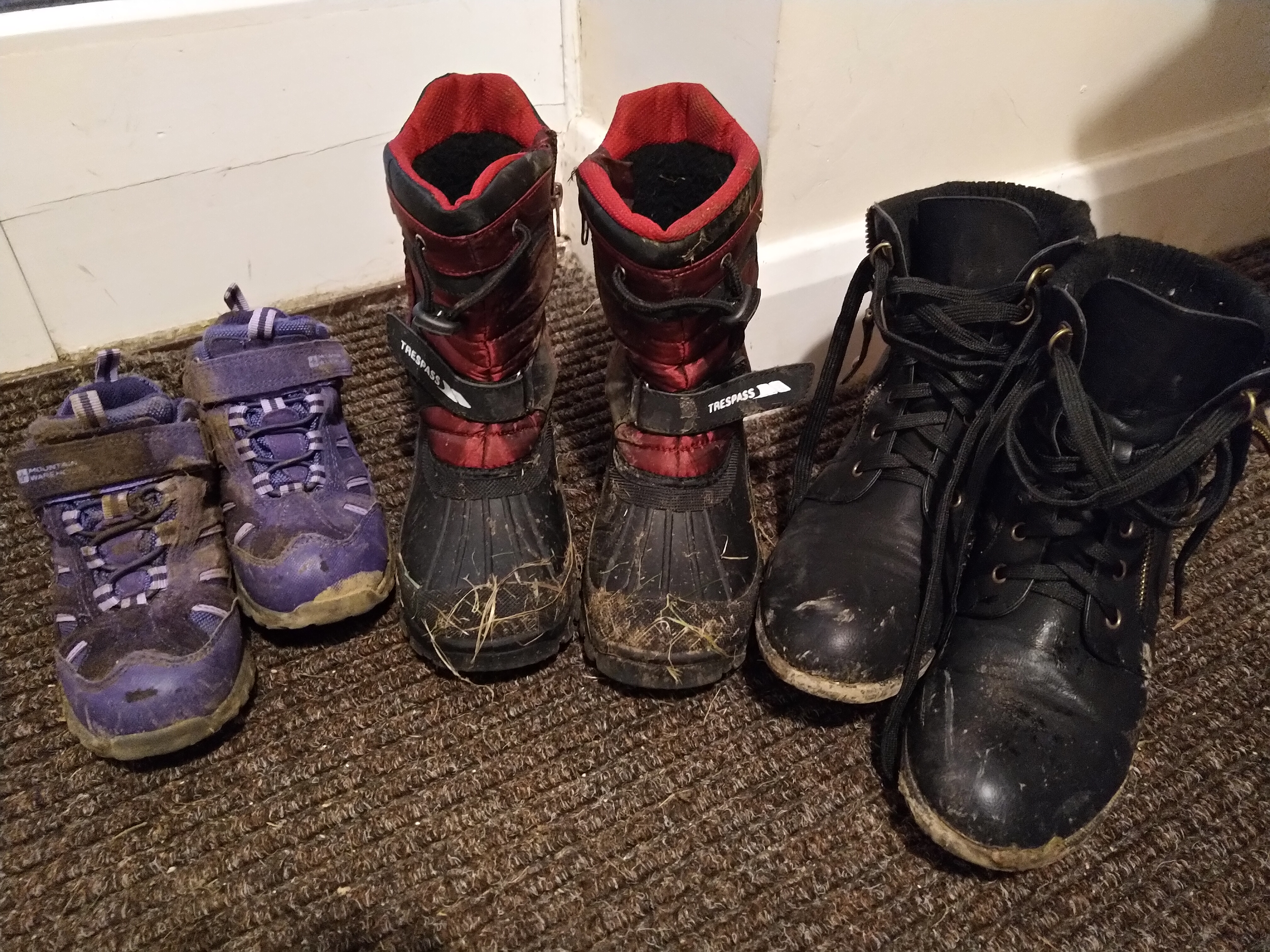
Muddy boots. Shame cleaning them is really not a strong point for me!

Expectations are a killer, especially at this time of year. I have relatives in the house I haven’t seen for months. I have my husband and children in the house at the same time, which hasn’t happened since the beginning of Advent (or at least, that’s how it’s felt for most of this month). And yet, it’s Christmas time. Therefore, every moment had to be Meaningful. Every day has to be filled with Making Memories. And so the pressure mounts, and we forget that actually, what we are doing right now is already exactly what we need. We forget that what we need is to enjoy what is here, and now, and not spend our energy and focus on what we hoped to be doing, or on what other people might be doing. I, in particular, forget that Boxing Day is, in fact, a gift – an oasis of calm and tranquility after all.

The footpath at Stowe Gardens