Learning a new language: privilege, self-examination and hope

Privilege is a word that has only fairly recently become part of my vocabulary. About time too, but that leaves me, like many others, feeling like I’m playing catch-up, with guilt making me question all the benefits I have gained – am still gaining – without ever consciously asking for those advantages.

When we talk about privilege, are we talking about things that make us feel proud? Feel loved? Feel lucky? Or are we talking about things that give us an unearned advantage in life, purely based on something we have little control over – our gender, our race, our physical ability?

The privilege of a lifetime is being who you are.

Joseph Campbell

The problem with language, glorious though it is in ever so many ways, is that here we are talking about both; and sometimes what we are talking about is equally part of both meanings. This post is my attempt to process things that are still new, confusing, and sometimes seem contradictory to me. If I get it horrifically wrong, please do correct me. Nicely, if possible, but if not I’ll try to understand.

In the process of writing this post, I also accepted what should probably have been self-evident: privilege is not an individual thing. In a culture dominated by individualism, this is a topic that, like faith, football and community action, can only really make sense when it is not practised alone.

One of the things I value about Quakers is their ability to ask open questions that expose more possibilities than they expect answers. One of the things we sometimes fall short on is remembering to talk about the myriad ways in which these questions might be answered. One such set of questions was asked at the most recent Yearly Meeting. I found them both helpful and challenging, and though I appreciate why they were not answered at the time, I look forward to hearing where other people might be on many of these issues, as Britain Yearly Meeting continues to explore, deepen, and act on these ideas over the next few years.

If I was to answer those questions now – well, some of them; I can’t remember them all – here is what I would say.

Q: Have you ever been the only person in a room with your skin colour?
A: Yes. But that doesn’t mean I understand, in my tummy and through my own experiences, what it is to be isolated and categorised purely on the colour of my skin. My own experiences of this are themselves steeped in the privilege that surrounds me, that made these experiences possible in the first place, and underlined by the worldwide impact of Britain’s colonial past:

  1. About 2 months into a transformatory period of volunteering, on the coast of Kenya, I was invited to the home of one of the staff, to talk about writing essays and to meet his new wife. I was the only white person not only in that home, but in the whole village, at that moment at least; and I was feted as a result to an extent I found deeply uncomfortable. Noticed, yes; judged or sidelined, definitely not.
  2. A few years later, the dire conditions in the refugee camps near Calais hit the headline news. I was invited to a fundraiser for the people living in The Jungle. It had a bouncy castle, a Frozen tribute act, and candy floss. I had two daughters who were under 5. Obviously, we were there in a flash. So were around a thousand other people. And for some time (until my husband, far better known in the area, arrived) there were only five white people in the room: Elsa and Anna on the stage, my daughters, and me. Some people looked at us in distaste. Some people looked with anger. Some people said nice things. Under it all was a palpable feeling of what are you doing taking over even this space, that is meant to be ours?
  3. Now, I am frequently the only person with my skin colour in a room. But I am at the front, the focal point of the room, and my language and experience shapes every lesson. My students – adults and often older than I am – are uncomfortable treating me as informally as I ask them to. One student was amazed when I wiped the board myself, instead of asking her – my senior, and someone who had also been on her feet at work all day – to do it for me. This unequal position is not due solely to my skin colour – they would have equal respect for any other teacher – but still, even when the only person of ethnicity in a room, my privilege is never left at the door.

Q: Did you grow up in a house with more than 50 books?
A: Yes. Oh, yes! I grew up in a house that probably had 50 books in every room. I live in a house now that definitely has 50 books in every room. It doesn’t feel like a home without them. But what does that mean in terms of privilege? Not that I grew up in a wealthy home. Although we never went hungry, as children, we weren’t well off either. I learned the meaning of “frugal” pretty early on, and in a supermarket at that. So being surrounded by books isn’t the same thing as wealth. Is it the same as being middle class? Again, no. Growing up, the books were my parents’. Although my father was middle class, my mother was proudly not. Her parents, who worked hard with their hands, in trades that might now be artisan but back then were not, instilled in her the belief that the education she could have and they did not was the best way to change her world, not by leaving behind her roots, but by being the best she could without anyone saying otherwise.

And yet, if privilege means unearned advantages, to me, coming from the household that I did gave me privilege. My parents read to me as a child: in Dad’s case, the whole of the Lord of the Rings. With the voices. They helped me with homework – and between them and my terribly smart, depressingly laid back, older brother, I had help with every subject up to A Level maths. My parents never said that reading was for losers, and didn’t have to hide their own fear or uncertainty behind making it sound dull. They never suggested that I couldn’t do science or maths because I am female – in fact, quite the opposite. University was an expectation and the household timetable was organised around enabling that. And now, a qualified teacher with a mountain of debt and the option of working in a variety of fields I care about, I know just how many doors are opened to me not because I am smart, not because I sound posh, but because I have good GCSEs, and a few letters after my name. Did I work for them? Yes – some a lot more than others. Did I get there purely on my own merit? No. No more than Jacob Rees-Mogg or Donald Trump are self-made men.

Q: Can you publicly display affection to your partner without fear of the reaction?
A: As a heterosexual, happily married, cis woman, yes, I can. I do not fear that people will hurl abuse – or worse – at either of us. They will not mutter, stare, or even notice us. Unless, that is, my husband is in work clothes. As an Anglican priest, he spends much of his time in a cassock. Which means that I have walked through shopping centres; held hands with; even kissed a man in a cassock in public (though maybe not quite as often as he might want me to…) And that means that I have been stared at. I have heard people questioning around us, full of judgement and negativity. I have heard people shout abuse and accusations of paedophilia at the man I love and not had the courage to do anything back. We are Christians, in a culturally Christian country, and with that comes a lot of things that make life easier. But living in a society that sees you living out your faith as an outmoded throwback at best, and an active participant in a horrific period of failing within a worshipping community that should always have been better than that, guilty by association, at worst; that is not the normal picture we paint when speaking of privilege.

Q: Have you ever been blamed for your own illness? (They didn’t actually ask that. I think maybe they should have done.)
A: As I have said before, I am overweight. I have always been “big boned”, but being tall helps it to not dominate people’s first impressions of me. But recently, I transitioned from that to someone who has high cholesterol. This, apparently, is the point that you start being a thing, instead of a person. Someone who gets told that you should “think about eating 5 a day” to make yourself healthier. No one asks what I’m already doing. No one checks why it’s hard. The assumption is that I am this way because I am lazy or ignorant of how to look after myself. End of story.

Is being thin a privilege? I don’t know. Does it open doors? Yes. Does it change how others see you, well before you open your mouth? Yes. But is it unearned? For some people, maybe, but for others, no. They have worked hard for the bodies they have, and have to continue doing so to keep them that way.

There are some things, protected characteristics that clearly carry with them discrimination and privilege. But this is not a straightforward subject. There are grey areas, uncertainties, confusion. I do not yet have all the language I need to discuss and learn from others’ experiences, and my own. What I can say is that no one is only privileged (well, almost no one, anyway). For those of us who have benefited more from privilege over the years, though, it is time to step up to the mark, own our own lives, and roll up our sleeves to start serving those who have not had as many open doors and step ups as they deserve. Not because we need to, but because we want to. Not because of fear, but because of hope. Not because of guilt, but because of love.

Picture from Pixabay: https://pixabay.com/users/ivanovgood-1982503/

Waste not; want a lot

I have just come back from a little time at the Yearly Meeting of the Religious Society of Friends (Quakers) in Britain. It’s hard to explain what this means to people who have never experienced it, but here’s my current best attempt. Over 1000 Quakers from all over Britain (and a fair few visitors from all over the world) gather in one building in central London for 3 days, and worship and work together to discern where we are at the moment, and where God needs us to be, in ourselves, our community, and the world. It is the very definition of organised chaos – there are never going to be enough toilets for that number of people to use in a 20 minute session break – with a lot of hugging (not a fan) and a lot of gin (bit too much of a fan). Before this year, I would have described the group as fairly homogeneous, but I wouldn’t do that now. Although it is not yet close to being the embodiment of diversity in action that we would like it to be, I think as a Society we will be healthier, happier and able to welcome others more sincerely if we continue and deepen the work done so far, speaking as clearly about how we are already different as we do about how we are the same.

“Quakers Meeting” by Thomas Rowlandson is licensed under CC CC0 1.0

As part of a wider exploration of Privilege and Power, we were also thinking about sustainability in the face of the climate emergency. The words currently ringing through my mind, pushing me out of my comfort zone in all the right ways, are “I need to do everything I can do. Then I need to do a little bit more.” But I don’t want to do a little bit more. I feel like a lot of the time I’m at breaking point already. How can I do more?

But, of course, I can. No, it won’t be easy, or I would have done it before. But as the same speaker said, I can’t look my children in the eye and say, in 30 years time, that I’m sorry I didn’t love them enough to leave them a world they can enjoy with their own children, in the way I can enjoy this world with mine. How can I deprive them of sharing the thrill of rolling headlong down hills covered in wildflowers (and plenty of things we all pretend are not hiding under the grasses); of counting the spots on ladybirds; of always knowing there will be enough food in the cupboards to keep them safe from hunger (even when half a loaf of bread has once more gone fluffy in the bread bin)?

So I need to do more. What can I do? How am I being called to change my life, and through that, help to make being more sustainable part of the collective default?

A phrase that I always associate with my grandmother (who was born into extreme poverty, lived in London through both World Wars and lost her parents-in-law to the Blitz) is “waste not, want not”. She also loved “If a job’s worth doing, it’s worth doing well.” In my head, whenever I hear that, I hear it in my own mother’s voice, with that slightly horrified tone of “did I just turn into my mother?” When I say it (and I do), I would imagine I say it with exactly the same inflection…

Waste not, want not. It has a visceral memory of rationing running clear through it. And it is in direct opposition to most of the way that things are made and marketed in modern society. But what does it mean to me?

The main areas of unquestionable waste in my daily habits are buying clothes I do not need, and eating too much. And in both of these areas, saying no to wasteful habits means saying no to things that I really, really want, if only in that moment. Saying no to consuming more than I need, more than is healthy, more than is right, is saying no to waste. It is also saying that I have to learn to resist the yearning that floods through me for that moment of indulgence and zoning out when tucking into a doughnut or three in the gasp between lessons; or the siren call of inhabiting that body and luxuriating in that lifestyle slithering its way into my subconscious as I dash into town for pens or the chemist.

I am a firm lover of lists and making plans (and usually slightly weaker at actually actioning those plans), and so I have been thinking about how I can create ways around me of reducing waste, and in particular, of stopping throwing away so much spoiled food, and eating so much food that I really don’t need – ways that are sustainable long term, by not adding straws to our already-creaking camels’ backs. I started this year intending to do something different and sustainable every month, a lifestyle change I called #Challenge2019. This (admittedly quite overdue now) is its next installment. So here we go.

I have said before that food waste in our household happens for a number of reasons. I buy healthy food and then don’t have the energy to cook it, so it goes off. (I’m not talking about going past its sell by date here, incidentally – I’m talking liquid cucumbers and green yogurt). I buy chocolate and crisps as occasional treats, and we all end up eating them as the satsumas go hard and brown in the fruit bowl. I cook what feels like the right amount of food, and put too much on our plates, so that we all end up either throwing some away (The Paleontologist) or eating until our tummies hurt (both The Cowgirl and me). I come home from work or days out, full of good intentions, and then snack on cheese because I need a quick boost and everything else takes effort. Then I put too much food on my plate when tea is finally ready and the cycle continues.

Working on all these things at once is impossible for me. Trust me – I’ve tried it I don’t know how many times, and it has never worked. Small changes, embedded one by one and built on slowly, is the only way I can see this working. This week, we’re looking at 5 a day. As a family, our challenge is to eat 5 portions of fruit or veg a day. If we do, we each get to put a cork (reused, of course 😉) into a pot. When there are a full week’s corks in there, we get a family treat.

How does this help sustainability, I hear you ask? I’m hoping, in lots of ways. It will mean snacking on the short-lived fruit and veg already in the house, instead of crisps and sweets. It will encourage me to incorporate more veg into meals, and hopefully give the girls the incentive to eat them instead of them going straight from the pan into the food waste canister. As we all get better at adding daily corks to the family total, I’m also hoping to bring in ideas about where our fruit, in particular, was grown, and how it reached us. And yes, it’s also about encouraging us all to eat more healthily, which might also help me to fit into more of my old clothes, meaning I don’t have to buy more when I have a whole wardrobe of clothes already that I don’t want to admit I may never be able to zip up again. Wouldn’t it be great to address both areas of waste in my life at once?

Is this going to save the world? Clearly not, with just me on my own, saying the same thing over and over to my nuclear family. Is it going to help? Yes. It will help me, but it is also a way of living my faith and my conviction, making the choices and sacrifices I can right now, helping my children and myself see I mean what I say, and that hard choices for me can look everyday and commonplace for others around me. And that’s ok. They may have their own hard decisions which I can support them with, which if we’re all lucky may be something that someone else they know has already overcome, and can show them the way around.

This is me doing everything I can, and then a little bit more. When this is normal, I will do a little bit more of the little bits more. What do you do that is a little bit more? And what can I do to help?

Take a deep breath

soap-bubble-2258904_1920
Image by Gerd Altmann from Pixabay

A couple of years ago, we went on holiday to Valencia. Whilst there, we learned many useful life lessons: beaches and dinosaur museums are almost as good for bribery as Haribo and ice cream; Spanish meal times are the way forward (breakfast until 11 as a normal thing? It makes life so much more civilised!); never expect a child to walk more than 3 metres in direct sunlight, unless you have earplugs or there is ice cream at the end of it (at which point, running and leaving you behind, panting in the heat, becomes way more fun). The most lasting lesson, however, was one I learned alone, on a sun-filled stressful family adventure to the beach. The children were finally old enough to be watched by just one adult, and having a fabulous time getting covered in as much sand as possible, so my husband and I took it in turns to go out of our depth and actually swim in the sea. It had been so long since I’d done this, my body had completely forgotten what to do. Waves came towards me and I panicked, freezing and fighting to stay in control. The wave passed. I remembered I can actually tread water pretty well. I looked out to sea, saw there were no immediate waves, and took a breath. The next wave appeared, and my body started to remember that it knew what it was doing. By the third wave, I had it, relaxing into the incoming surge, focussing on the moment, accepting that when the waves came, they were not there to be fought but to be ridden, to be felt, endured sometimes. And then they passed. There was a moment of stillness in which to breathe.

Take a breath.

It is advice I dish out with joyful abandon, and almost never take myself. I say it to my students: if you are getting panicky in an exam, look out of the window and take a deep breath. Let it out. Count the beats to make sure you are breathing more slowly than normal. Keep going until the voice in your head stops repeating “I can’t do this” at the top of its lungs and lets you listen to the question in front of you instead.

Take a breath.

I do this with The Cowgirl, whose emotions regularly consume her entire being. Excitement needs to be jumped and wriggled out. Exhaustion has her curled in a bundle like a nesting cat. Fury cannot be contained in her tummy but comes out in screams and flying fists. Actually, I think this is probably more healthy than the volcano I often have bubbling in my gut, but that doesn’t help if you’re on the receiving end of one of her deceptively strong left hooks. So she screams for a while until fury turns to fright, and then she huddles on my lap and we recover together. We take a breath, feeling the air together, bypassing our lungs and going straight into our bellies. We compare who has the biggest tummy, and I stop holding mine in. We blow out and try to blow each other over. And we keep taking breaths until the anger has passed.

Take a breath.

Trying to get up when it takes everything in you not to cry at the pain running like acid down your spine, you suck air through your nose as hard as you can. Controlling your body as your instincts control you, you pant through contractions before a long low exhale and a baby’s first, faltering inhale. Laughing like maniacs as you lie on your tummies, sharing secrets, you inhale in whoops to try to limit embarrasing consequences. Learning how the world works and what your interactions do to it, you gently breathe out bubbles, whoosh away dandelion clocks, puff out birthday candle flames.

Take a breath.

The thing about taking a breath is that, however perfect that breath is, however much it gave you exactly what you needed in that moment, it can never be enough to stop, to not need to do it again. In the next moment, after a few heartbeats, you need to do it again. And again. And again. The cycle is always necessary, and endlessly repetitive. Most of the time we pay no attention to it at all, until something comes up that gets in the way and makes us focus by breaking the rhythm.

Take a breath.

Today may be an amazing day. Today is allowed to be the day you get it all right. Today can be the day you have the right answer to a crisis at work, or you get home with the time and energy to chat about discoveries, sorrows and playground shenanigans before the bedtime conveyor belt starts. Today might be the day you keep going with fighting bad habits or finally take a step towards building up better ones. Today might be the day everything goes entirely as you wish it to. And then tomorrow comes, the cycle starts again, and the mystery and mayhem of a new dawn takes over. And tomorrow may not be perfect. And that’s ok.

Take a breath.

Everything that matters in life follows that same pattern. Breathing. Eating. Learning. Loving. Growing plants and making memories. Reading, teaching, worshipping, praying. Sometimes it is perfect. Sometimes it is not. Sometimes it gives you everything you are craving. Sometimes it does not. Sometimes the answer appears in your heart before the sentence has even made it past your lips. Sometimes your cries echo for years, unanswered and seemingly unacknowledged. And whatever the moment, the feeling, the answer, next time, you get to do it all again. We want to see results, to know there’s a reason for all this. The rhythm keeps repeating and we look for meaning from the centre of the cycle and cannot find it.

Take a breath.

That answer will come. Every time you do this, it has an effect that cannot happen without what you have done. Each repetition is important, even when the results can only be seen after a long and cumulative journey. Creating a sustainable future; learning the alphabet; trusting that you are actually doing quite a good job of this whole life thing: all these things are made up of tiny moments, none of which are turning points, all of which are important.

You have this. We all do. Sometimes we can see it in ourselves. Sometimes we need others to find it in depths we are too tired to dig through alone. But it is always there. You’ve got this. If not in this moment, then in the next. Or the next. Or the next.

Take a deep breath.

I am dust.

Ash Wednesday is dissonant. It is jarring. It makes me wriggle in my chair and want to cower behind the cushions at the same time.

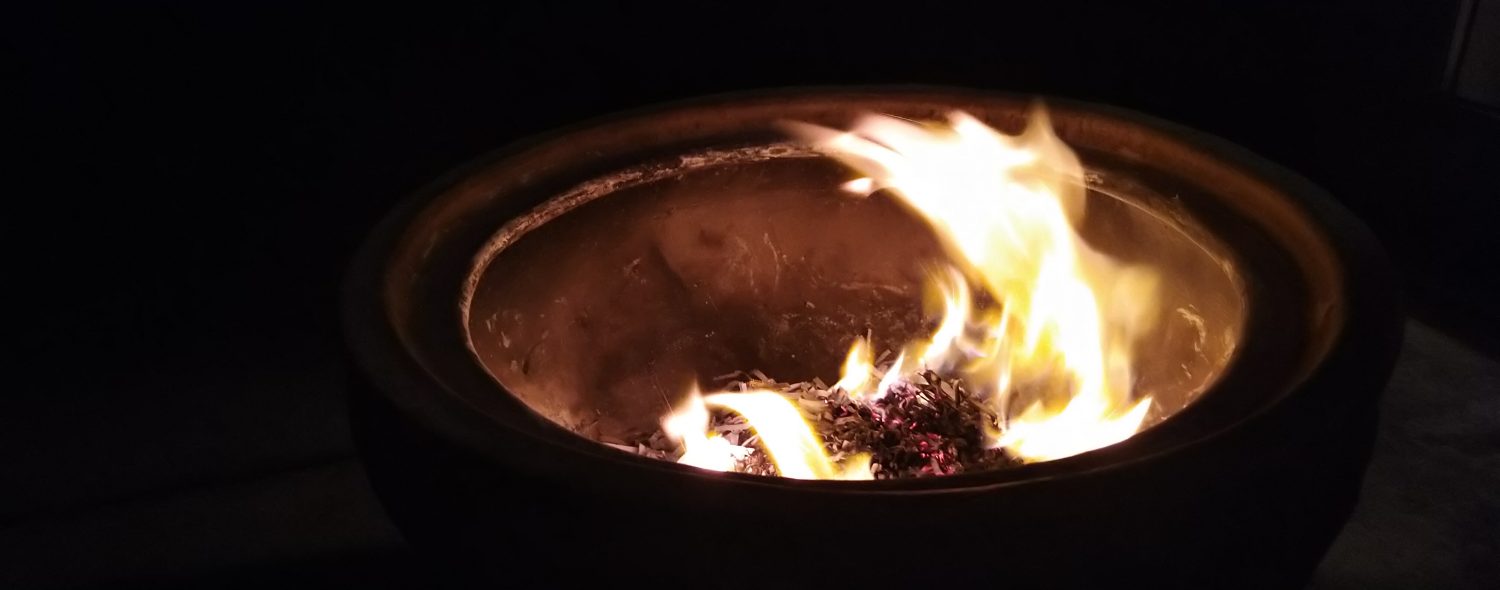
I stand, in a beautiful church shimmering with gold, and have cold, damp ashes thumbed onto my forehead. They were made earlier in the week in my back garden, smoldering in the barbeque as the joy-filled palm crosses disintergrated into black, crispy mulch.

Remember that you are dust.

My children stand beside me, quiet because everyone around them looks different to a normal Sunday, quivering with pent-up energy made worse by knowing they cannot let it out. The solemnity hangs in the air, unexplained, inviting and incomprehensible.

To dust you will return.

My husband turns from me and gently, hand shaking just a touch, marks the cross on the forehead of each child, remembering their own mortality whilst doing everything he can to forget it. At least, that’s what I assume he’s thinking; I know it’s there in my mind.

I stumble back into the real world, awkwardly engaging in conversation when all I really want to do is be still, and breathe, and try to assimilate the fact that I have just had my own mortality literally pasted onto my forehead. In that moment, there is no turning away from the fact that this is me, and I will die, and that is part of why I am here.

Walking down the street, the dissonance follows me. Eyes do a double-take on seeing my forehead. Should I tell her she has something on her face? Is she one of those crazy people? No one mentions it. Everyone sees it.

I leave the church dreaming that this year, everything will be different. I will be thoughtful, and helpful, and kind every day through Lent. I will give up the food that is bad for me, and take up an act of kindness every day. I will pray more, and read the Bible every day, and come out of it knowing exactly what God wants of me.

All too soon, life intrudes again. Tomorrow is World Book Day, and so there is a Paleontologist to be transformed into Hermione Granger, and a Cowgirl who has decided that in fact, when she grows up, she wants to be a Tiger (because the Tiger is very naughty, and eats all the food in the cupboards, and I want to be like that too). Marking needs to be done. Meetings need to be had. Washing needs to be hung out to dry.

Usually, by this point in the evening, my pious intentions have already crumbled into dust. This year, the process started early, as I didn’t even make it to the Ash Wednesday service; the car had a flat tyre, and absorbed All Time into an abyss. So instead, in this pause when the wand is away, the tiger costume is hanging up, tomorrow’s marking is just about finished, and the house is asleep, I am trying to reach that point of stopping, and breathing, and waiting.

Because Ash Wednesday is not just dissonant because it reminds you that you will die, standing there in the midst of the busyness of everyday life. It is also jarring because it throws the knowledge that, in fact, none of this is about me, right into my face. Lent is not a sanctified excuse to lose weight. Nor is it the chance to answer those big questions about where my life is going or what might happen next to me. It’s not a time for self-congratulation, or self-absorption, or starting new projects.

Lent is a time when we remember what it is like to be lost and alone. It is a time of wandering through the desert, not knowing yet how the story will end, and having to trust that everything will happen as it should. It is a time of madness, and forgetting, and self-discovery. It is a time for remembering what it is to be homeless, and hopeless, and hungry. But more than that, more than anything else, it is a time of waiting. It is a time of listening. It is a time of holding on while the storm crashes by, because only then, in the resulting stillness, can the voice of God be heard.

And so, tonight, I am waiting.

field-2179118_1920
Image by Pexels on Pixabay